
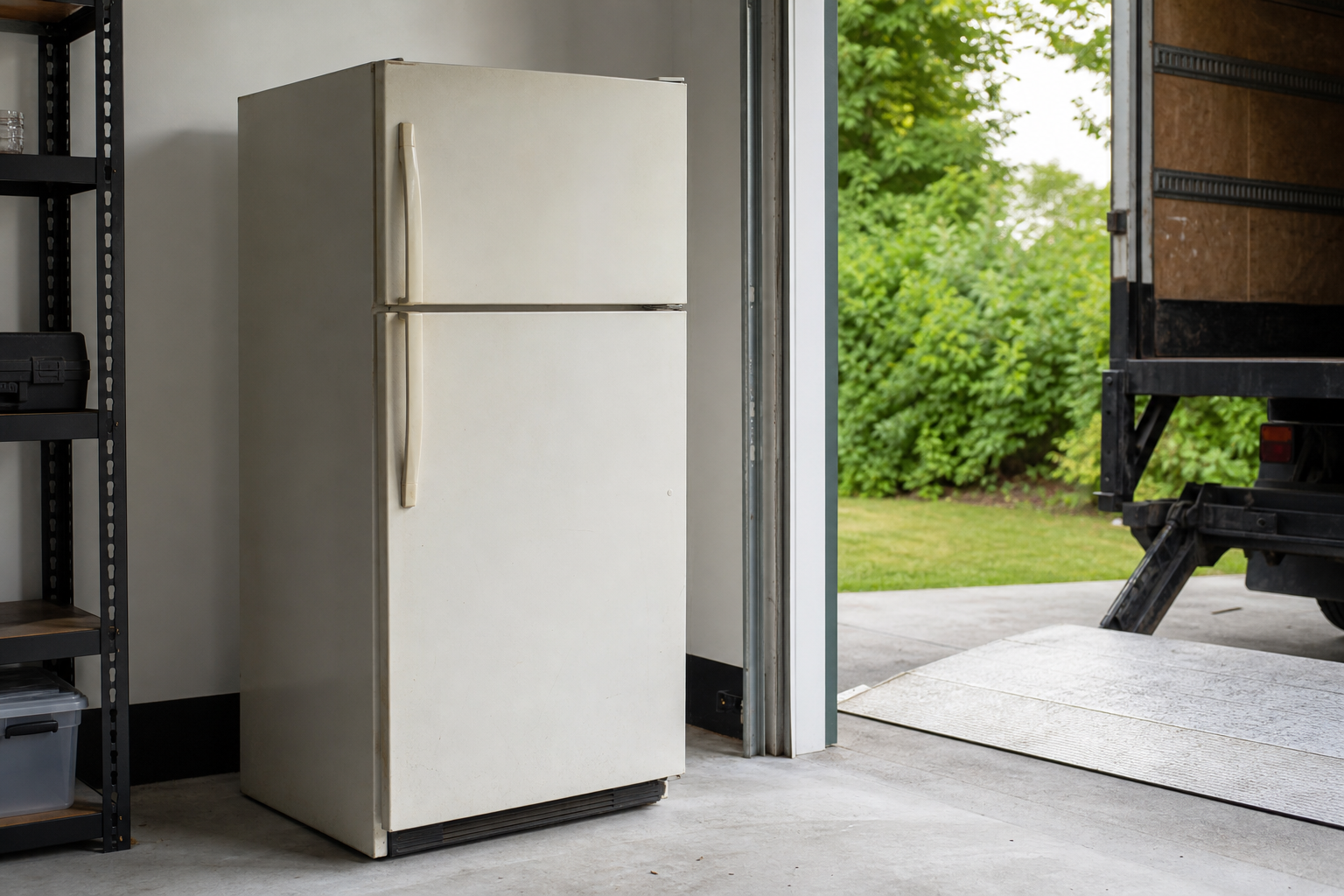
You may be able to receive money for an old refrigerator, but there is no universal payout. A scrap buyer assesses the refrigerator as a mixed appliance, with value affected by weight, recoverable metals, cleanliness, preparation, current market conditions, and confirmed acceptance terms.
For homeowners in Etobicoke and the GTA, the useful question is not only “How much is my refrigerator worth?” It is also whether the expected payment justifies the work of moving the unit and whether the receiving yard can handle an intact sealed system.
Choose the Cash Route That Fits Your Refrigerator
Yes, an old refrigerator can sometimes produce cash, but the best route depends on its condition, construction, and your ability to transport it. Quick Scrap Metal buys scrap metal, home appliances, and electronics for cash, but refrigerator-specific acceptance and payment terms should be confirmed before you travel.
If the refrigerator still works
Compare any current utility or community recycling reward with a scrap-metal assessment. A reward program may offer a fixed payment for an eligible working appliance, while a scrap buyer evaluates the unit’s material value instead.
A reward program may be the better fit when the refrigerator meets its rules and the program provides a convenient collection service. Scrap recycling may be more relevant when no suitable reward is available or when you want the appliance assessed with other qualifying materials.
If the refrigerator does not work
A broken refrigerator may not qualify for a working-appliance reward, but it can still be worth asking a scrap buyer about recycling. Acceptance depends on the refrigerator’s condition, missing parts, sealed-system status, and the buyer’s handling requirements.
Describe the unit as nonworking when requesting an assessment. Do not assume that a broken refrigerator is automatically accepted, and do not dismantle it to try to increase its value.
If the refrigerator is damaged or difficult to move
Visible damage, missing parts, stairs, narrow doorways, and limited vehicle access can change the practical value of the transaction. If the unit cannot be moved without tipping, dragging, or risking damage, ask the receiving business whether it can accept the appliance and what delivery arrangements apply before moving it.
Is it worth scrapping a refrigerator? It can be when the appliance is already being replaced and you have a safe, practical way to deliver it. Compare the expected net payment with fuel, equipment, helper time, and any collection charge instead of focusing only on the possibility of cash.
Cash Options for an Old Refrigerator
There are three relevant paths: a fixed-reward recycling program, a scrap-metal assessment, or a general disposal route when neither cash option fits. The right choice depends on the refrigerator’s condition and the terms available in your area.
| Route | Typical eligibility | Payment structure | Your effort | Best fit |
|---|---|---|---|---|
| Utility or community reward | Often requires a working appliance and other program conditions | Stated reward if the unit qualifies | Follow the program’s collection or delivery process | A working refrigerator and an eligible current program |
| Scrap-metal assessment | Depends on the buyer, appliance condition, and component-handling rules | Material-specific assessment based on the unit and current rates | Arrange safe delivery unless another option is confirmed | A homeowner seeking cash for an appliance that may not meet reward rules |
| General disposal route | Depends on local collection or facility rules | May provide no payment | Follow the collection or drop-off requirements | A refrigerator that is not accepted for a reward or scrap assessment |
Do not assume that a cash reward and scrap value are interchangeable. A reward is usually tied to eligibility, while scrap value depends on the materials and the cost of handling them.
What Your Refrigerator May Be Worth
There is no reliable refrigerator-wide cash figure without an assessment and a current rate for each material category. Quick Scrap Metal describes scrap pricing as market-driven, with value affected by metal type, grade, cleanliness, weight, preparation, and current market conditions.
A refrigerator is a mixed assembly, not one uniform grade of scrap. Its gross value may reflect recoverable steel, aluminum, copper-containing wiring, and other materials, while non-metal components and handling requirements affect what a buyer can offer.
- Weight: A heavier unit contains more material, but weight alone does not determine the rate.
- Metal mix: Steel, aluminum, copper-containing wiring, and other metals may be assessed differently.
- Condition: Missing parts, damage, moisture, food residue, and contamination can affect inspection and handling.
- Preparation: An intact, empty appliance is easier to assess than one that has been cut apart or partially dismantled.
- Market conditions: Scrap rates change, so an assessment today may not match a later assessment.
- Handling: Transport, collection, access, labor, and processing requirements can affect the net result.
Use a gross-versus-net calculation
A practical estimate has two parts:
Gross material value − transport or handling costs = estimated net amount.
For example, a buyer may assess the refrigerator’s steel, non-ferrous components, and other recoverable material as separate categories. Add those category values to estimate the gross assessment, then subtract any confirmed delivery, labor, equipment, or removal costs. Do not subtract a made-up rate. Ask for the categories used, the weight or basis for each category, and every charge that affects the final payment.
Before taking the appliance to a scrapyard, review how scrap metal prices are influenced by metal type, cleanliness, weight, preparation, and market conditions. If you are separating loose, non-hazardous copper-containing material already outside the refrigerator, understanding scrap copper prices can explain why clean copper is assessed differently from mixed material.
When requesting an assessment, provide the refrigerator type, approximate dimensions, working condition, visible damage, whether it remains intact, and your preferred delivery arrangement. Ask whether the final amount will be based on the whole appliance, separated material categories, or both.
Prepare the Refrigerator Without Creating a New Hazard

Prepare the refrigerator by emptying, defrosting, drying, securing loose parts, and planning the move. Safe preparation stops before refrigerant, compressor, fluid, battery, or electrical work.
- Remove all food, drinks, ice, and personal items.
- Defrost the freezer and let the interior dry.
- Remove loose, non-hazardous shelves, bins, and containers without force.
- Secure shelves and drawers so they do not shift during transport.
- Secure the doors so they do not swing open.
- Measure doorways, stairs, hallways, and vehicle space.
- Clear the route and arrange an appliance dolly or capable help.
- Protect floors, walls, and vehicle surfaces from sharp edges, water, and tipping.
The key safety limit is simple: do not vent, puncture, cut, or dismantle the sealed refrigerant system. Do not open the compressor, drain unknown fluids, cut electrical lines, or remove components requiring technical handling at home.
For more appliance-specific guidance, see how to prepare appliances for recycling safely. Remove ordinary household contents, secure the appliance, and leave hazardous or sealed components intact until the receiving provider gives different instructions.
Delivery or Collection: Calculate the Practical Value

Self-delivery may fit if you have a suitable vehicle, safe loading equipment, enough help, and a clear route to the receiving yard. A collection service may be worth asking about when the refrigerator is heavy, located on stairs, trapped in a tight space, or impossible to load safely.
Do not assume that collection is available, free, or included in the payment. Ask the business whether refrigerator collection is offered, whether your unit and location qualify, and how any transport or labor cost would affect the net amount.
Self-delivery may fit when:
- The refrigerator is accessible and can be moved without unsafe lifting.
- You have suitable secure transport.
- You want the appliance assessed at the yard.
- You are combining it with other metal, appliance, or electronics recycling.
Collection may fit when:
- The appliance cannot pass safely through the home without specialized equipment.
- You lack a suitable vehicle or enough help.
- The refrigerator is bulky, damaged, or difficult to load.
- Convenience matters more than maximizing the gross material payment.
Compare the likely cash assessment with fuel, equipment, helper time, and confirmed collection charges. The route with the highest stated payment is not always the route with the best net result.
Confirm the Details Before You Load It

Give the recycler enough information to decide whether your visit is practical and whether the refrigerator can enter its recycling stream.
- State whether it is a refrigerator, freezer, combination unit, or another appliance.
- Provide the approximate size and, if available, the model or a photograph.
- Say whether it works, does not work, is damaged, or has missing parts.
- Explain whether it remains intact and whether the sealed system has been disturbed.
- Describe stairs, narrow access, elevators, and distance from the vehicle if collection is being discussed.
- Ask whether yard delivery or collection is available for that specific refrigerator.
- Ask how the appliance will be assessed and whether any charges affect the payment.
Quick Scrap Metal is located at 407 Rexdale Blvd, Etobicoke, ON. Confirm current hours, refrigerator acceptance, payment terms, and delivery or collection arrangements before departure.
What Happens After Recycling?
After acceptance, the refrigerator enters an appliance and scrap-recycling stream where recoverable metals can be assessed and directed for recycling. The exact downstream process depends on the appliance, its condition, the receiving facility, and component-handling requirements.
Leaving the refrigerator intact, removing household contents, and confirming acceptance helps the receiving yard assess the load without creating an avoidable hazard.
Frequently Asked Questions About Refrigerator Cash Recycling
Can I get money for a broken refrigerator?
You may be able to get money for a broken refrigerator through scrap-metal recycling, but acceptance and payment depend on the buyer’s assessment. Describe the damage and missing components before bringing it in.
How much money can you get for scrapping a refrigerator?
There is no verified universal amount. A useful estimate starts with the assessed value of the refrigerator’s material categories, then subtracts confirmed transport, collection, labor, or handling costs.
Does Quick Scrap Metal accept refrigerators that still contain refrigerant?
Quick Scrap Metal’s public information does not confirm refrigerator-specific acceptance for an intact unit containing refrigerant. Ask before moving it, and do not vent, puncture, cut, or remove sealed-system contents yourself.
Is it better to use a utility reward program or sell a refrigerator for scrap?
A utility or community reward may be better for an eligible working refrigerator when it offers a fixed payment and practical collection. Scrap selling may be more relevant when the appliance is broken or a reward program is unavailable, but the result is less predictable.
Will Quick Scrap Metal collect my refrigerator?
The supplied public information does not confirm refrigerator-specific collection availability, cost, or eligibility. Ask Quick Scrap Metal about the appliance’s condition, address, access details, and whether collection is available before moving the unit.
Plan Your Next Step in Etobicoke
Gather the appliance type, approximate size, condition, photographs if useful, location, access details, and preferred delivery arrangement. Then confirm acceptance, the assessment process, current hours, and any transport or handling terms before moving the appliance.
For an Etobicoke refrigerator or other household appliance, contact Quick Scrap Metal about appliance recycling services before you load or dismantle the unit.