Before you book appliance removal in Etobicoke, decide whether the job is a yard drop-off, a collection request, or an in-home removal. The right choice depends on the appliance’s condition, weight, access route, connection status, and whether it contains refrigerant or other regulated components. Quick Scrap Metal is at 407 Rexdale Blvd in Etobicoke, but confirm the item’s acceptance, collection options, access requirements, and disconnection responsibilities before moving it. Related reading: Dump removal.
The right appliance removal route depends on the appliance and the job
Start by deciding whether your priority is preserving the appliance, removing it with minimal effort, disposing of it responsibly, or recovering value. The practical route changes with condition and access.
- Working appliance: Repair, resell, donate, or ask the retailer delivering its replacement about take-back. Reuse usually makes more sense than scrapping an appliance that still performs safely.
- Repairable appliance: Compare the repair cost and likely remaining service life with the cost of replacement and removal. Do not dismantle it just to reach a motor or wire unless you understand the risks and the work is appropriate.
- Damaged or obsolete appliance: Compare municipal disposal, confirmed collection, retailer take-back, and a scrap-yard assessment. Metal content may create value, but payment is not automatic.
- Heavy or difficult-to-access appliance: Ask about arranged removal before moving it. Basements, stairs, narrow halls, long carries, and tight parking areas can change the practical cost and whether a provider can handle the job.
- Unsafe appliance: Stop if it is leaking, swollen, unstable, badly damaged, electrically compromised, or contaminated. Describe the condition before arranging transport instead of placing it in a vehicle.
For a kitchen renovation, donation or retailer take-back may be the simplest low-cost route if the appliances work. For a rusted washer, broken stove, or mixed load of old appliances and metal, a scrap assessment may be more useful than paying a general junk-removal fee. A yard drop-off is not the same as in-home removal: you bring the item to the yard unless collection is separately confirmed.
Which appliances may fit a scrap or recycling assessment?

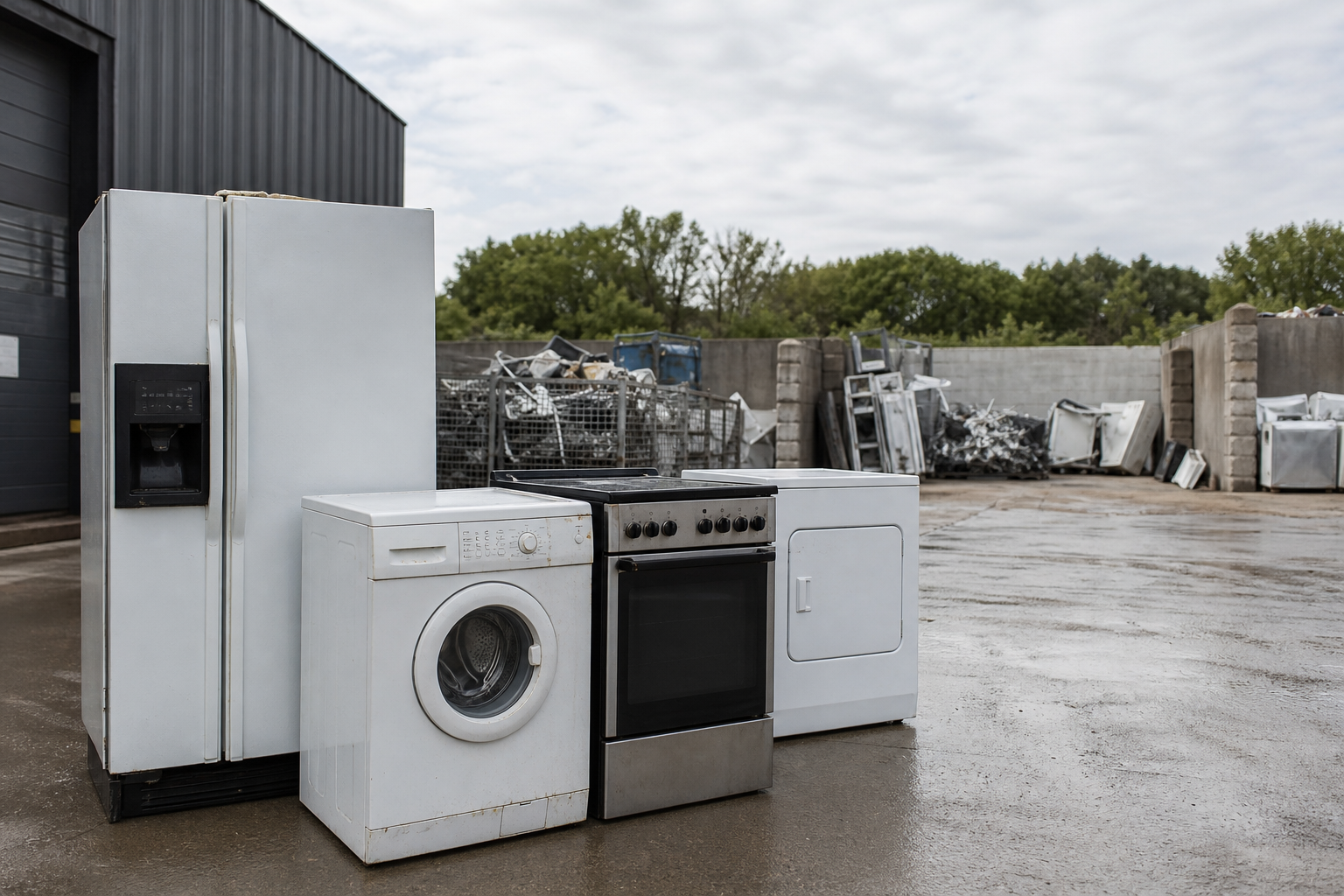
The appliance types below are a planning list for a removal conversation, not a verified acceptance list for every yard, condition, or collection request. Describe the exact appliance to Quick Scrap Metal before travelling, especially if it is unusually large, damaged, connected to a utility, or difficult to access.
| Appliance | What may affect the assessment | What to confirm before moving it |
|---|---|---|
| Washer | Steel body, motor, wiring, weight, completeness, and contamination | Whether it can be dropped off or collected, and who handles draining and disconnection. For preparation and value factors, review the washing machine scrap price guide. |
| Dryer | Steel cabinet, motor, wiring, drum, and overall condition | Whether any gas connection must be handled by a qualified person and whether the unit is suitable for the proposed route. |
| Stove or oven | Steel, wiring, controls, burners, and contamination | Gas or hardwired disconnection responsibilities before pickup or transport. |
| Dishwasher | Steel, stainless steel, wiring, pump, and remaining water | Who disconnects water and electrical connections and whether the unit must be drained first. |
| Microwave | Steel housing, wiring, motor, and electronic components | Whether it should remain intact. Do not open the unit to remove internal components. |
| Refrigerator or freezer | Steel, aluminum, copper, insulation, compressor, and refrigerant system | How the sealed system must be handled and whether the provider accepts the unit through drop-off or collection. |
| A/C unit | Metal casing, copper, aluminum, compressor, and refrigerant | Whether the unit requires a specialist route and how refrigerant handling is arranged. |
| BBQ | Steel, stainless steel, cast metal, burners, and attached fuel components | How any propane cylinder or other fuel component must be handled separately. |
| Water heater or related equipment | Tank metal, fittings, insulation, wiring, and residual water | Gas, electrical, and water disconnection requirements, plus whether residual water must be removed. |
Appliance value often comes from a combination of materials, not from the appliance’s original retail price. A complete unit can be easier to assess than a partly dismantled one, especially when removing parts creates sharp edges, loose debris, or a new transport problem.
What affects appliance removal cost or scrap value?
Removal cost and scrap value are two different financial paths. A removal provider may consider the appliance’s size and quantity, distance, stairs, carrying distance, parking, lifting, access, and whether disconnection is required. A scrap buyer looks more closely at the appliance type, weight, metal mix, completeness, contamination, preparation, and current market conditions.
Quick Scrap Metal describes scrap-yard prices as varying with material type, grade, preparation, contamination, market demand, and weight. Its published guidance also explains that prices change with global commodity conditions and local demand, so an online number cannot establish the payment for your specific appliance. You can review the factors behind scrap yard prices before asking for an assessment.
Qualifying scrap may be paid in cash, but not every appliance produces a payment. A mostly metal, complete appliance may be assessed differently from a damaged unit with substantial non-metal material, contamination, or extra handling needs. Ask whether the item is being assessed as scrap, accepted only for recycling, or handled through another arrangement.
Should you remove copper from an appliance before selling it?
Usually, do not strip copper or dismantle an appliance simply to chase a better payment unless the work is safe, lawful, and genuinely worthwhile. Dismantling can expose sharp metal, stored energy, wiring, oils, or sealed systems.
Sort loose scrap separately if it is already detached and safe to transport, but keep appliance components together when the unit is complete. Describe the appliance and any separate materials when you ask about the route.
Refrigerators, freezers, and A/C units need a separate safety decision
Do not release, remove, or handle refrigerant yourself. Ontario states that only a certified technician may remove, discharge, handle, and dispose of regulated refrigerants and other listed halocarbons. Ontario’s refrigerant-handling requirements explain the certification rule.
Moving an intact refrigerator, freezer, or A/C unit is different from opening its sealed system. Keep lines, compressors, and fittings intact, avoid cutting tubing, and ask the receiving yard or removal provider how the appliance must be handled before you transport it.
If you are comparing a utility recycling offer, a retailer take-back program, municipal disposal, or a scrap route, treat each as a separate service with its own eligibility, scheduling, and handling rules. A program outside Ontario does not establish an option for Etobicoke, so local residents should choose an Ontario-appropriate municipal, retailer, technician, or recycling route.
Prepare the appliance before pickup or drop-off

Good preparation reduces spills, delays, property damage, and confusion at the scale. Use this sequence before arranging collection or loading a vehicle.
- Identify the appliance and route. Note the make, model, approximate dimensions, working condition, and whether it contains refrigerant, gas, water, or a hardwired connection.
- Empty the unit. Remove food, clothing, dishes, racks, shelves, loose batteries, and personal items. Keep removable parts together if they belong with the appliance.
- Disconnect only what you are qualified and permitted to disconnect. Confirm responsibility for gas, water, electrical, and refrigerant work before the appointment or trip.
- Drain and clean where appropriate. Washers should be drained and loose debris removed. Keep motors and wires attached unless a provider gives different instructions.
- Secure moving parts. Tape or strap doors, lids, hoses, cords, racks, and loose panels so they cannot swing or fall during movement. Do not seal a refrigerator in a way that creates a child-entrapment hazard while it is being stored.
- Measure the route. Check doorways, stair turns, elevator dimensions, garage clearance, driveway space, and the vehicle opening.
- Protect surfaces and the vehicle. Use suitable padding and containment for water, dirt, oil, and sharp edges. Keep the load upright when required.
- Arrange suitable help. Heavy appliances can tip, crush fingers, damage floors, or cause lifting injuries. Do not move one alone or improvise with inadequate straps, ramps, or a vehicle that cannot secure the load.
For a fuller preparation sequence covering refrigerators, washers, dryers, and other appliances, use the appliance preparation guide. Clean and secure what you can safely prepare, but leave refrigerant systems and uncertain utility connections to the appropriate qualified route.
How Quick Scrap Metal fits the Etobicoke removal decision
Quick Scrap Metal is located at 407 Rexdale Blvd in Etobicoke. The business buys and recycles scrap metal and also handles home appliances, electronics, and other scrap categories. Cash on the spot applies to qualifying scrap, not automatically to every appliance or removal request.
The business is open on Sundays and closes late on weekdays, which can help if a weekday or weekend drop-off fits your schedule. Opening hours do not by themselves confirm that a particular appliance can be collected, unloaded from a home, or accepted without advance discussion.
Before travelling, describe the appliance type, quantity, dimensions, and condition. Also state whether you can drop it off at the yard or need collection, whether it came from a basement or upstairs room, whether stairs or long carries are involved, and whether gas, water, electrical, or refrigerant connections remain.
This information helps separate three different requests: a yard drop-off, an appliance or household scrap assessment, and a removal or collection inquiry. If your load includes metal items with different grades, sort them where practical because preparation and contamination can affect the assessment and handling time.
Questions to ask before arranging appliance removal
Can I get paid for an old appliance instead of paying a removal fee?
Possibly, if the appliance and its recoverable materials qualify as scrap, but payment depends on the assessment. Ask whether the item is eligible for purchase, whether you must bring it to the yard, and whether any collection charge or other arrangement applies.
Does Quick Scrap Metal remove appliances from basements or upstairs rooms?
Do not assume that in-home removal, basement access, stairs, or upstairs carrying is included. Ask Quick Scrap Metal directly whether collection is available for your item and access conditions, or plan a yard drop-off with suitable equipment and help.
Do I need to disconnect gas, water, or electricity before appliance removal?
Confirm this before booking or loading because the available service details do not establish who performs disconnection. Gas, hardwired electrical, water, and refrigerant connections may require a qualified person or a different service route.
What should I do with a refrigerator or air conditioner that contains refrigerant?
Keep the sealed system intact and ask the receiving provider about acceptance and handling before moving it. Do not cut lines, discharge refrigerant, or remove the system yourself because Ontario requires a certified technician for that work.
Once you know the appliance’s condition, access, connection status, and whether you can deliver it, you can choose the route with fewer surprises. For a local assessment of an appliance or mixed scrap load, contact Quick Scrap Metal’s appliance and scrap recycling services before travelling to the Etobicoke yard.