
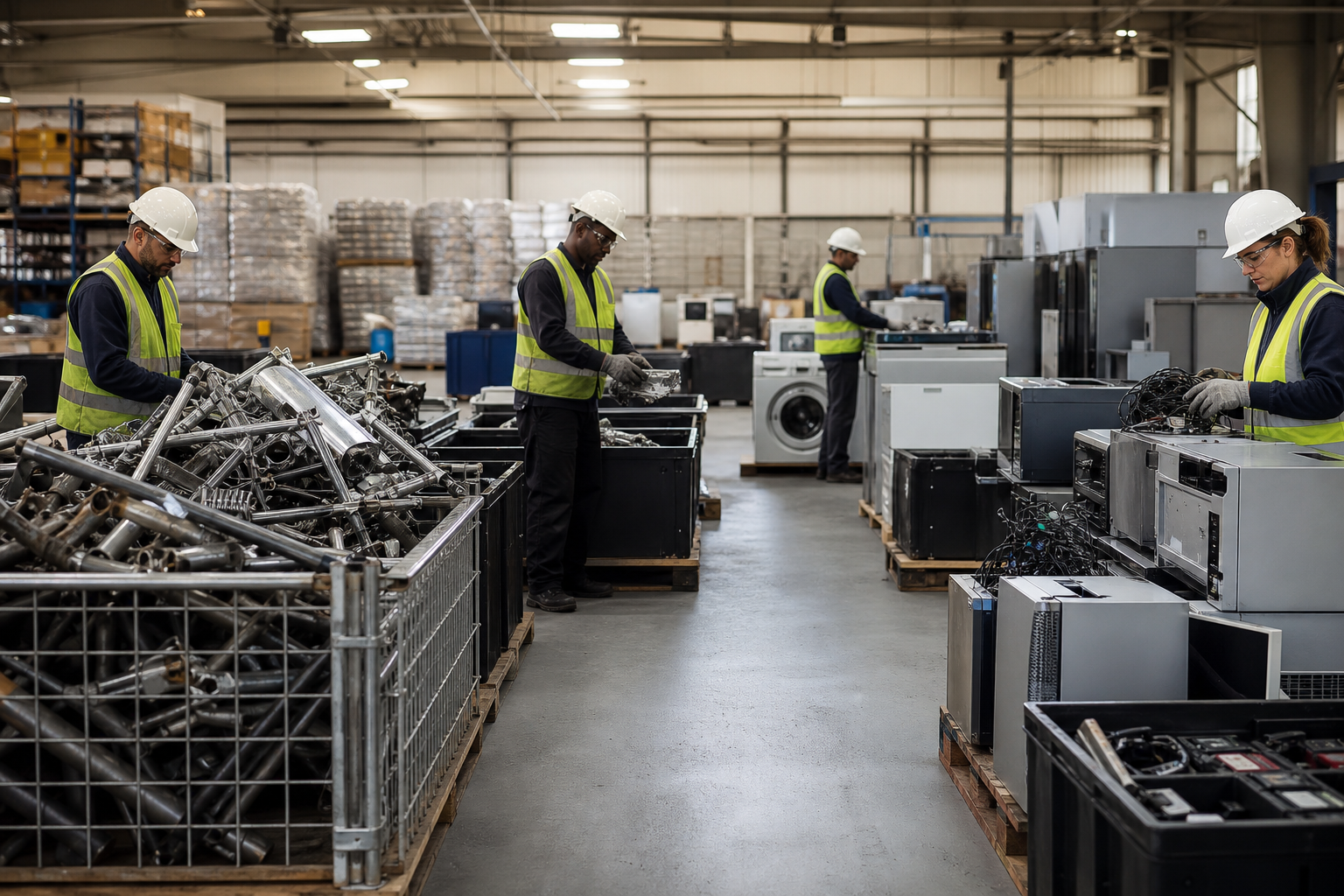
Surplus inventory is material a business no longer needs at its current quantity, timing, or specification. It can include excess stock, obsolete parts, damaged goods, production offcuts, appliances, electronics, and idle equipment. Start by separating items that still have resale or reuse value from material better suited to recycling or scrap recovery, then document the type, grade, quantity, condition, location, and access before requesting an assessment.
This approach helps warehouse managers, contractors, and purchasing teams compare holding, selling, reusing, recycling, and scrapping each category instead of treating every unwanted item alike. The right decision depends on recoverable value, space pressure, labor, timing, and whether the material can still serve its original purpose.
Surplus Inventory Management Starts With the Right Classification
“Surplus” does not automatically mean worthless. It means a business has more of an item than current operations need, or the item no longer fits its intended use.
- Safety stock: Extra material held deliberately to protect against supply delays or demand changes.
- Excess inventory: Stock above the quantity needed for forecast demand, production, or known projects.
- Slow-moving inventory: Material that still sells or gets used, but slowly enough to create storage and aging concerns.
- Obsolete inventory: Material made unusable by a changed specification, discontinued product, or replacement equipment.
- Damaged stock: Items affected by rust, impact, moisture, oil, missing parts, or contamination.
- Scrap: Material whose practical route is recovery of its metal or component value rather than reuse as the original product.
These categories can overlap. Steel components may be excess for one production line, useful to another department, or scrap if the specification has changed and no buyer wants them. A batch should therefore be classified by both condition and likely destination.
Inspection, storage control, reuse, recycling, auctions, transfers, and scrap disposal are connected parts of surplus-material handling. Canada’s 2024-25 departmental report describes surplus inventory management alongside warehousing, divestment, and procurement planning.
Why Surplus Inventory Builds Up and What It Costs to Keep
Common causes include inaccurate forecasts, bulk-buying discounts, minimum order quantities, seasonal demand, supply disruption, changed specifications, cancelled projects, slow sales, and equipment replacement.
Metal stock can also accumulate because it is hard to identify or move. Mixed grades, short offcuts, partial bundles, obsolete components, damaged appliances, and untested electronics can occupy space until their practical value falls further. A business may also keep material because no one has been assigned responsibility for deciding what happens next.
Separate the cause from the response
The cause often points to the best corrective action. A forecasting problem calls for better demand review. A supplier minimum-order problem may call for revised purchasing terms. A discontinued component needs a disposition decision, not another reorder adjustment. Production offcuts may require a cutting-plan review or a defined recycling route.
Use a holding-cost worksheet
- Space: Record floor area, rack positions, cages, or outdoor space occupied.
- Handling: Estimate time spent counting, moving, stacking, inspecting, photographing, and retrieving it.
- Operational burden: Include blocked access, forklift movements, temporary storage, and disruption to active stock.
- Protection and administration: Consider packaging, weather protection, records, insurance, and staff time.
- Obsolescence risk: Note whether specifications, models, or customer requirements may change.
- Recovery effort: Estimate listing, negotiating, dismantling, cleaning, and transport time.
Expected net recovery = likely proceeds minus preparation, transport, labour, and continued storage costs.
This is a planning method, not a promised offer. A lower-value load that clears space in one organized trip may be more practical than a higher theoretical resale value that requires months of storage.
Compare the cost of waiting
Suppose a pallet of obsolete metal housings might recover $1,200 through resale after testing, listing, storage, and several hours of labor. If those activities cost $350 and the pallet occupies a location needed for active stock, the practical recovery is closer to $850 before the cost of delay. A scrap or recycling route with lower gross proceeds may still be the better business decision if it removes the storage burden quickly.
The same calculation applies to equipment and appliances. Include loading, specialist disconnection, internal approvals, and the risk that a damaged or outdated item becomes harder to sell. Do not compare a clean scrap estimate with a resale price unless both figures account for the work needed to achieve them.
Classify Metal, Equipment, Appliances, and Electronics Before Choosing a Route
Record each material group separately. Begin with ferrous metals such as steel and cast iron, then separate non-ferrous metals such as copper, aluminum, brass, nickel, and stainless steel.
Identify production offcuts, cable and wire, radiators, motors, transformers, obsolete components, appliances, computers, televisions, circuit boards, batteries, and mixed loads. “Mixed metal” is less useful than a description of what the load contains.
Scrap value depends on material type, grade, cleanliness, preparation, weight, and the market rate available when sold. Reviewing metal prices per pound is useful only when comparing like with like. Clean copper wire, insulated cable, painted steel, stainless components, and aluminum with attachments do not represent the same grade or processing requirement.
Use a four-part inventory record
- Identity: Record the material, model, alloy or grade if known, original use, and any label or specification.
- Quantity: Capture units, approximate weight, dimensions, pallet count, bin count, or container volume.
- Condition: Note whether it is new, used, rusty, oily, wet, damaged, incomplete, dismantled, or mixed.
- Practical route: Mark each group as internal reuse, resale, liquidation, donation, recycling, or scrap assessment.
Sort enough to improve clarity
Separate obvious categories that your team can identify safely and consistently. Keep copper away from steel, aluminum away from general ferrous scrap, and electronics away from loose metal. Group similar appliances and identify batteries or other items needing separate handling.
Sorting can make weighing and grading more straightforward, but it does not guarantee a higher offer. Do not dismantle equipment when doing so creates a hazard or requires specialist handling. The goal is a clearer inventory record, not maximum disassembly.
Choose Reuse, Resale, Liquidation, Recycling, or Scrap Recovery
Choose the route that produces the best practical outcome, not necessarily the highest theoretical price. Use condition, demand, labor, storage cost, urgency, and material identity as the decision criteria.
| Route | Best fit | Main benefit | Main tradeoff |
|---|---|---|---|
| Internal reuse | Material meets an active specification | Avoids a new purchase | Requires a real project, owner, and timeline |
| Resale | Identifiable, usable goods with buyer demand | Potentially higher recovery than scrap | Requires marketing, testing, packing, and customer coordination |
| Liquidation | Usable goods where speed matters | Can clear varied stock in one process | Offers reflect demand, condition, logistics, and buyer risk |
| Donation or transfer | Safe, usable material with a suitable recipient | Moves stock without commercial resale work | May not recover cash and still requires records and transport |
| Recycling | Appliances, electronics, and materials needing recovery | Provides a defined end-of-life route | Acceptance and preparation requirements vary by material |
| Scrap recovery | Obsolete, damaged, mixed, or metal-rich material | Turns recoverable metal into a practical disposition | Payment depends on grade, weight, market, and processing needs |
- Reuse internally when material still meets an active specification and another department or project can use it.
- Return or repurpose when a supplier agreement, replacement project, or internal repair program offers a realistic path.
- Resell as usable inventory when condition, identification, packaging, and buyer demand justify finding a customer.
- Liquidate when speed and warehouse recovery matter more than maximizing every item. Pricing reflects demand, condition, testing, storage, marketing, logistics, and risk. There is no universal percentage of original cost.
- Donate or transfer when material is safe, usable, and appropriate for another organization.
- Recycle or sell as scrap when material is obsolete, damaged, mixed, difficult to sell, or more valuable for recoverable material than as a finished product.
For businesses holding metal, appliances, or electronics, recycling and scrap recovery may be the practical endpoint after reuse and resale have been ruled out.
Use a decision rule for uncertain items
If an item has a known specification, intact condition, and a likely buyer, test resale or internal reuse first. If it is identifiable but demand is uncertain, set a short review deadline and compare the likely proceeds with listing and storage costs. If it is damaged, mixed, obsolete, or primarily valuable for its material content, move it toward recycling or scrap assessment.
Set a deadline for each route. An item that remains listed without inquiries is not proving its resale value. It is accumulating handling and storage costs, so reassess the route instead of allowing it to remain in indefinite “pending” status.
Worked Example: Disposition of a Mixed Surplus-Metal Batch

Hypothetical example: A manufacturer finds five categories occupying warehouse space after a product specification change.
| Material | Condition | Initial route | Next action |
|---|---|---|---|
| Copper offcuts | Clean and separated | Resale or scrap assessment | Record approximate weight and keep separate from steel. |
| Steel brackets | Usable but discontinued | Reuse or resale first | Check whether another project can use them. |
| Aluminum parts | Some attached to fasteners | Sort and assess | Separate obvious groups and record attachments. |
| Old appliances | Out of service | Appliance recycling or scrap | List type and condition, then plan safe movement. |
| Mixed electronics | Obsolete and untested | E-waste recycling | Remove company data where applicable and separate from loose metal. |
The business compares the cost of keeping the stock for another quarter with preparing an assessment request. Copper may move to scrap assessment, steel may be offered internally, and obsolete electronics may enter an appropriate recycling stream. The example shows how one stockpile becomes several specific decisions without inventing a recovery price. Related reading: Shopify Supplement Store Management in Toronto.
Why one mixed quote can be misleading
Combining every item into one estimated value can hide the difference between high-value non-ferrous material, lower-value ferrous material, appliances, and e-waste. It can also make it harder to identify missing units or explain why some items require separate handling.
A category-based record gives the business three useful comparisons: the value of keeping each group, the cost of preparing it for a chosen route, and the net outcome after space and labor are included. That is more useful than assigning a single value to an unidentified pile.
Prepare an Inventory Review or Scrap Assessment Request
Prepare these details for each material group:
- Category: Identify steel, copper, aluminum, brass, stainless steel, appliances, electronics, batteries, or cable.
- Quantity: Provide counts, approximate weight, dimensions, pallet count, or container estimate.
- Condition: Describe whether material is clean, painted, oily, wet, rusty, damaged, dismantled, mixed, or attached.
- Photos: Show the storage area and close details such as labels, grades, attachments, and contamination.
- Location and access: State facility location, loading conditions, vehicle access, and whether equipment is needed.
- Ownership and documentation: Retain purchase, project, or decommissioning records where available.
- Timing: Explain whether the priority is immediate space recovery, a planned cleanout, or recurring collection.
- Sorting status: State which categories are separated and which remain mixed.
As general preparation, an upgrade pass can remove obvious non-metal attachments, while labeled containers or pallets help keep categories distinct. A short inventory of grades, estimated weights, and photos also makes it easier to discuss the material without guessing at a price. Copper sorting guidance can help teams describe offcuts accurately.
What Happens From Review to Weighing and Payment
A transaction begins with an inventory description, not a guaranteed number. The business explains what it has, where it is, estimated quantity, and whether the material is sorted. The buyer or recycler then considers suitable materials and the practical delivery or collection route.
Material is inspected and weighed. Grades, cleanliness, attachments, and condition affect categorization. The available market rate is applied to the assessed material, and qualifying scrap is paid according to the transaction terms.
Quick Scrap Metal buys scrap metal, home appliances, and electronics and provides cash payments for qualifying materials. Its published information does not provide a fixed online price for every material, so an assessment should be treated as material-specific rather than a percentage of book value.
Questions to resolve before loading
- Which categories are accepted in the planned load?
- Should the business deliver the material or discuss collection?
- Does the load need to be separated into pallets, bins, or other groups?
- What quantity, dimensions, photos, or access details are needed to plan the route?
- Which items require separate handling because of their condition or contents?
- What records should the driver or business representative bring?
These questions prevent a vehicle from arriving with an unclear load that needs to be unloaded, re-sorted, or redirected.
Small Drop-Offs and Commercial Volumes Need Different Plans

A small organized load may fit a drop-off. A warehouse cleanout, contractor stockpile, or recurring production stream needs a plan covering container size, loading method, access, and removal order.
For a small load, group the material by category, estimate the total weight or number of pieces, protect loose items during transport, and leave enough room to inspect each group. A commercial load benefits from a site sketch, loading sequence, container location, equipment plan, and named contact who can answer questions at dispatch.
For recurring material, measure the flow over several collection cycles. Note how many bins, pallets, or containers accumulate in a week or month, which grades are present, and whether the material is clean at the point of generation. That record can show whether a scheduled collection or on-site container is more efficient than repeated ad hoc trips.
Before moving a commercial load, document access routes, ground conditions, loading areas, overhead restrictions, operating hours, and material categories. Confirm equipment, timing, and handling requirements before scheduling.
Build Controls So Surplus Does Not Reappear
Review active inventory by age, movement, specification, project assignment, and storage location. Set an owner for items that have not moved and require a decision before they occupy another review cycle.
EOQ and ROP in practical terms
Economic Order Quantity (EOQ) balances ordering costs with holding costs. It helps determine whether order or transport savings justify added storage and aging risk.
Reorder Point (ROP) is the level that triggers replenishment. It usually reflects expected use during supplier lead time plus an intentional safety-stock allowance. If ROP is too high, the business orders before existing stock is used. If it is too low, supply interruptions become more likely.
- Run cycle counts on active and high-value materials.
- Review aging stock on a schedule suited to the operation.
- Flag specification changes before new purchases are approved.
- Require a project, customer, or forecast reference for bulk purchases.
- Coordinate with suppliers about returns and minimum order quantities.
- Separate reusable stock from scrap when a project closes.
- Track recurring offcuts so purchasing and cutting plans improve.
- Set a disposition date for damaged, obsolete, or unassigned material.
- Measure the space and labor released after each cleanout.
Good controls do not mean holding the minimum possible quantity. They mean knowing why material is being held, who needs it, when it will be used, and what happens if that plan changes.
Surplus Inventory Questions Businesses Ask
What is the difference between surplus inventory and safety stock?
Safety stock is deliberately held to protect operations from demand changes or supply delays. Surplus is material above current need or material that no longer fits its specification or purpose.
How do you calculate excess inventory for a mixed metal stockpile?
Establish quantities needed for active projects, normal usage, and deliberate safety stock. Subtract that requirement from usable quantity in each category. Calculate copper, aluminum, steel, appliances, and electronics separately.
When should a business recycle surplus inventory instead of liquidating it?
Recycling is usually more practical when material is obsolete, damaged, difficult to identify, mixed, or unlikely to find a buyer as a usable product. Liquidation suits identifiable, usable, marketable goods when speed matters.
What information should a business provide before requesting a scrap assessment?
Provide categories, estimated weights or counts, dimensions, photos, condition, contamination, location, loading access, ownership information, sorting status, and timing.
Do liquidators or scrap buyers pay a fixed percentage of inventory value?
No. Liquidators consider demand, condition, testing, storage, marketing, logistics, and risk. Scrap buyers consider material type, grade, cleanliness, weight, preparation, processing, and current market conditions.
Can mixed, rusty, or damaged metal still be considered for recycling?
It may still have recoverable value, but condition affects classification, handling, and processing. Describe rust, damage, moisture, oil, attachments, and mixed grades accurately. Unusual, hazardous, leaking, or regulated items require confirmation before transport.
Turn an Inventory Decision Into a Practical Next Step
Start with a category-by-category review, calculate the cost of keeping unwanted material, and prepare photos, quantities, condition notes, and access details. For suitable surplus metal, appliances, electronics, and related recoverable materials, Quick Scrap Metal is located at 407 Rexdale Blvd in Etobicoke. Review the available commercial scrap recycling services before arranging the next step.