
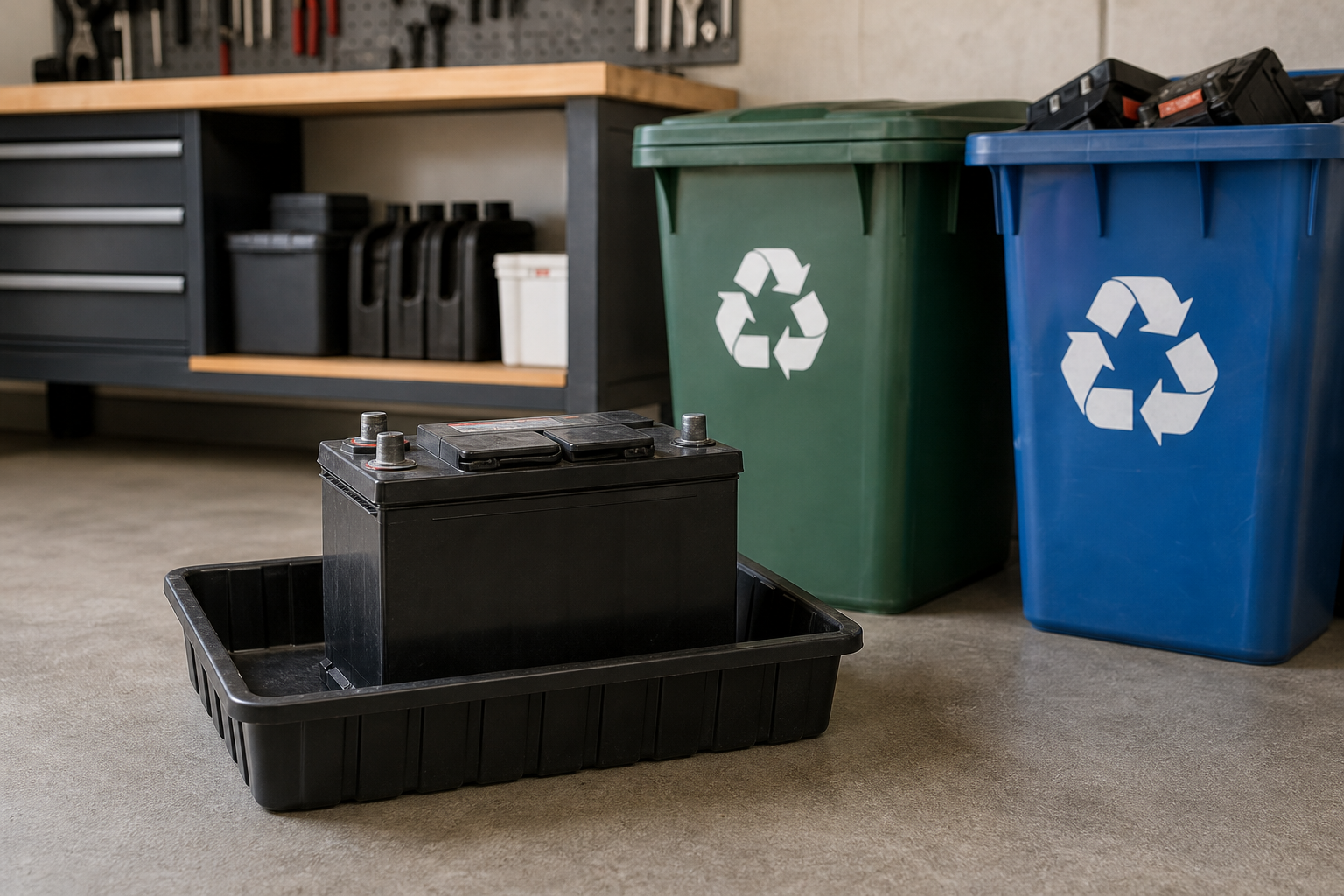
Safe battery recycling starts before you reach the yard. Keep intact lead-acid batteries dry, separate from loose scrap, protected at the terminals, and secured against movement. Then confirm that the recycler accepts your battery type before loading it into a vehicle.
This guide focuses on common automotive and industrial lead-acid batteries, such as spent car batteries. It also explains when a cracked, leaking, swollen, or hot battery should not be handled or transported casually.
Quick summary

- Identify the battery before recycling it. Do not assume every battery type belongs in the same recycling stream.
- Keep an intact lead-acid battery upright where practical, dry, stable, and separate from general scrap.
- Protect exposed terminals and prevent batteries from sliding, tipping, or striking one another during transport.
- Do not open, crush, puncture, heat, repair, or place batteries in household garbage.
- Stop and seek guidance from an appropriate authority or qualified handler if a battery is cracked, leaking, swollen, unusually hot, or otherwise damaged.
Identify the battery before you recycle it
Lead-acid batteries are commonly used in cars, trucks, equipment, and some industrial systems. Automotive starting, lighting, and ignition batteries are the familiar units found under a vehicle hood. Larger industrial batteries may look different and can be heavier, so identify them by their label and intended use rather than appearance alone.
Other battery categories require different handling and acceptance arrangements. Lithium-ion batteries, small household batteries, rechargeable packs, and damaged batteries should not automatically be mixed with lead-acid units. If you cannot identify the battery, keep it separate and ask the intended recycler what information it needs before accepting it.
Health Canada advises consumers to follow battery instructions and keep batteries away from children. See its battery safety tips. Ontario’s battery framework is set out in Ontario Regulation 30/20, but that regulation is not a complete set of instructions for every household handling or transport situation.
Lead-acid battery recycling safety checklist

For a normal, intact battery awaiting a planned drop-off, use this checklist:
- Inspect without opening it: Look for obvious cracks, leaks, bulging, heat, or severe damage. Do not remove the casing or examine the inside.
- Keep the case intact: Do not drill, cut, crush, dismantle, or modify the battery to recover lead or other components.
- Protect the terminals: Prevent posts or terminals from contacting metal tools, loose scrap, or one another. Use suitable terminal protection that does not require altering the battery.
- Keep it dry: Store the battery away from rain, standing water, damp areas, and heat sources.
- Sort like with like: Keep lead-acid batteries separate from copper, steel, aluminum, appliances, and loose electronics.
- Use stable containment: Place the battery in a sturdy container or on a surface that prevents tipping and movement. Do not rely on a thin cardboard box for a heavy unit.
- Keep children away: Store the battery where children cannot reach or handle it.
- Confirm acceptance: Ask the yard whether it accepts your battery type and whether it has special instructions for unusual units.
Safe actions versus common mistakes
| Safer approach | Avoid |
|---|---|
| Keep an intact battery stable, dry, and separated. | Throwing it into a mixed pile where it can be struck or tipped. |
| Protect terminals from contact with metal. | Carrying loose batteries beside tools, wire, or other conductive metal. |
| Check the label and ask about acceptance. | Assuming lithium-ion, household, or damaged batteries follow the same process. |
| Move only a normal, intact unit that can be secured safely. | Improvising transport for a leaking, cracked, swollen, or hot battery. |
| Leave the battery sealed and unmodified. | Opening, puncturing, crushing, heating, draining, or attempting a repair. |
| Keep batteries out of household garbage. | Putting one in a garbage bin, recycling cart, or loose household waste. |
Preparation should reduce movement, contact, contamination, and uncertainty. If an action requires dismantling the battery or handling a visible leak, it is not routine preparation for a household drop-off.
How to store and transport intact batteries
Until you arrange a suitable drop-off, store an intact battery in a dry, secure location where it will not be knocked over. Keep it away from children, heat, moisture, and items that could bridge the terminals. Do not stack it where the weight could damage the case.
Before leaving, contact the recycler with a basic description: battery type, approximate quantity, whether the cases are intact, and whether an unusual condition is present. This is especially useful for industrial batteries or several heavy units.
For transport, use a vehicle and container arrangement that keeps the battery upright where practical and prevents sliding or tipping. Keep it isolated from loose metal, tools, and other batteries that could collide. Do not leave it in a hot vehicle longer than necessary, and do not transport a battery that cannot be contained safely.
What to do with a cracked, leaking, swollen, or hot battery
An abnormal battery is different from an ordinary intact battery awaiting recycling. A damaged case, visible leakage, bulging, unusual heat, or evidence of serious impact means you should not treat the unit as routine scrap.
Do not open, puncture, crush, heat, repair, or transfer the contents. Do not place it in a garbage bag, mix it with scrap, or load it into a passenger vehicle simply because it is nearby. Keep people away from unnecessary contact and obtain instructions from an appropriate authority or qualified handler.
Do not assume that a scrap yard can accept every damaged unit. Call before bringing one to any facility, describe the condition accurately, and follow the instructions you receive. If the battery presents an immediate danger, use the appropriate emergency or local public-safety channel rather than attempting disposal yourself.
Prepare for drop-off and protect your payout
Battery value is not fixed. Assessment can vary with battery type, weight, recoverable lead content, condition, contamination, sorting, and current market demand. A clean, correctly identified load is easier to evaluate than a mixed or damaged one, but no preparation method guarantees a particular price.
For intact batteries, keep units of similar type together, protect the terminals, and remove unrelated material from the load. Do not attach loose copper, steel, plastic, tools, or general household scrap to the battery collection. Separating materials helps receiving and reduces confusion about what is being weighed.
Battery drop-off in Etobicoke
Quick Scrap Metal lists lead and batteries among its accepted scrap materials. The business is located at 407 Rexdale Blvd, Etobicoke, Ontario, M9W 6P8, near Highway 27 and Rexdale. Its published information refers to auto and industrial battery drop-off and on-the-spot payment.
Before making the trip, confirm that current intake instructions match your battery type and condition. This matters particularly for unusual industrial units or anything damaged, leaking, swollen, or hot. Acceptance of lead and batteries does not mean every battery category or condition is automatically accepted.
Frequently asked questions
Can I put a lead-acid car battery in a box with other scrap metal?
No. Keep it separate from loose metal, tools, wire, and other scrap that could contact the terminals or strike the case. Use stable containment that prevents movement, then confirm the recycler’s instructions.
Should I call a scrap yard before bringing in old batteries?
Yes. Call with the battery type, quantity, and condition. A call is particularly important for industrial, unusual, damaged, or leaking units.
How should I store a used lead-acid battery before drop-off?
Keep an intact battery dry, stable, and separate from general scrap. Protect its terminals, keep it away from heat and children, and avoid stacking it where it can fall or be struck.
Can I transport a leaking or cracked battery in my vehicle?
Do not casually transport one. Stop handling it, keep people away from unnecessary contact, and seek instructions from an appropriate authority or qualified handler.
Does battery condition affect the recycling payout?
It can. Type, weight, recoverable lead content, condition, contamination, sorting, and market demand may affect assessment. Rates vary and should be confirmed for the current day.
Does Quick Scrap Metal accept lead and automotive batteries in Etobicoke?
Quick Scrap Metal lists lead and batteries among its accepted materials and identifies its location as 407 Rexdale Blvd, Etobicoke. Confirm current acceptance before visiting, especially if the battery is not intact.
Recycle batteries safely by keeping the decision simple
For an intact lead-acid battery, identify it, keep it sealed and dry, protect the terminals, separate it from other scrap, secure it during transport, and confirm acceptance before drop-off. Do not dismantle or modify it to increase its scrap value.
Damaged, leaking, swollen, or hot batteries require a different decision. Do not improvise storage or transport. Seek guidance from an appropriate authority or qualified handler and describe the battery’s condition accurately before moving it.
For qualifying intact lead and automotive batteries in the Etobicoke area, verify the current instructions with Quick Scrap Metal before visiting its 407 Rexdale Blvd location.