
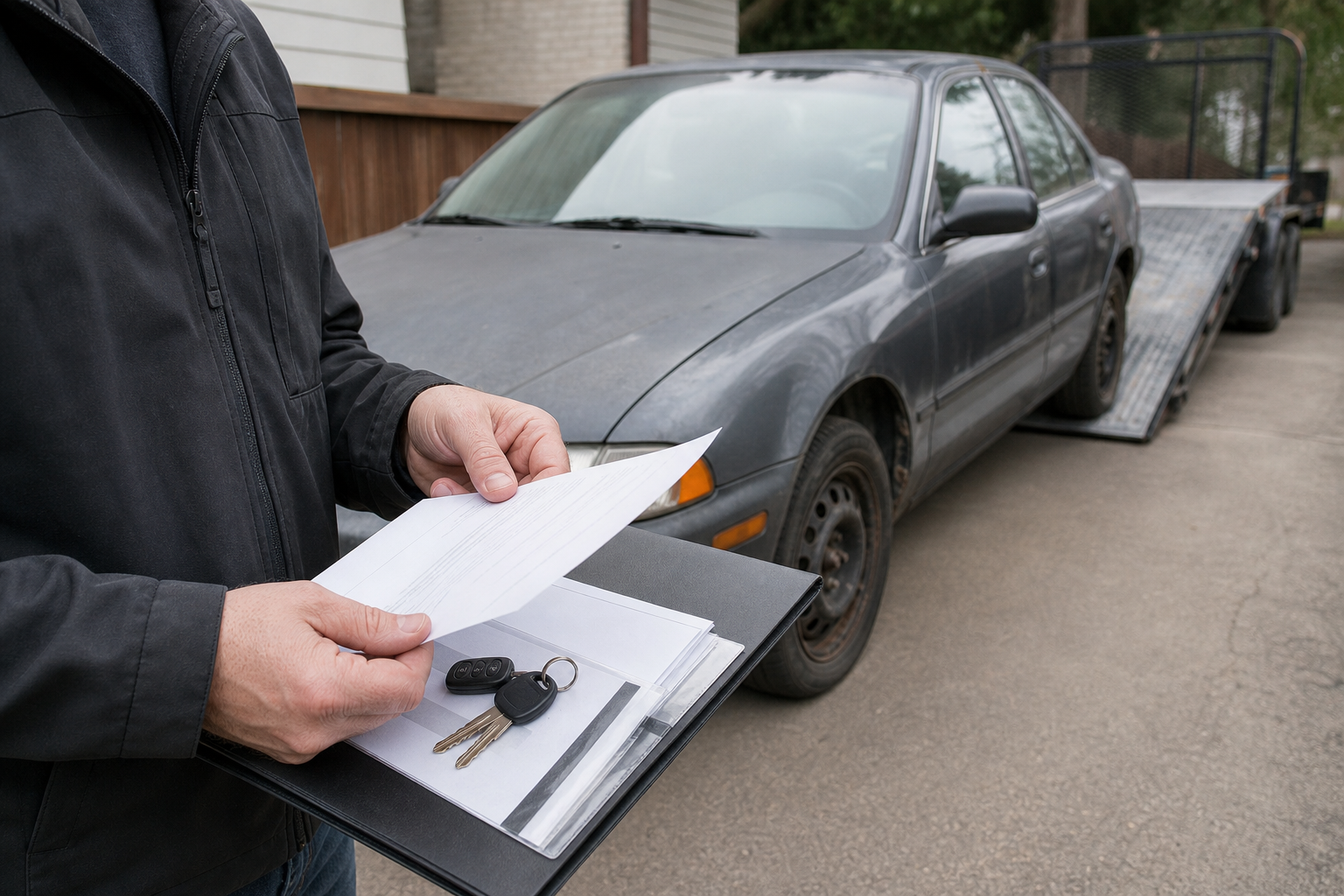
The documents needed to scrap a car in Ontario usually include government-issued photo ID, the vehicle ownership permit or other proof of ownership, available keys, and details about the car’s condition and location. Ontario’s official used-vehicle guidance also covers the Application for Transfer, bill of sale, licence plates, and Used Vehicle Information Package (UVIP), but a UVIP is not automatically required for every qualifying wrecking or dismantling transaction. Confirm the exact intake requirements with the buyer before travelling.
Start With the Document Bundle Most Owners Should Prepare
If you are the registered owner and the car is being sold for scrap, place these items together before arranging pickup or driving to a yard:
| Item | What it helps establish | What to know |
|---|---|---|
| Government-issued photo ID | Your identity | Bring current identification and ask whether a particular form is required for the transaction. |
| Vehicle ownership permit | Your connection to the vehicle | Bring the vehicle portion and any relevant ownership information you have. |
| Proof of ownership | That you have authority to dispose of the car | This may be the permit or another document the buyer accepts. Confirm alternatives if the permit is missing. |
| Vehicle keys | Access to the vehicle and its available components | Bring all available keys, but do not assume both keys are universally required. |
| Vehicle details | The car’s identity and condition | Have the year, make, model, VIN if available, running status, location, and missing parts ready. |
Quick Scrap Metal’s vehicle guidance identifies valid ID, proof of ownership, title status, vehicle completeness, and available keys as relevant preparation factors. Its scrap-car information also covers drop-off at 407 Rexdale Blvd in Etobicoke and pickup arrangements, so the same document bundle is useful whether the car moves under its own power or needs collection. Review the vehicle preparation details before you request an assessment.
If you are also selling loose metal, appliances, or electronics, separate those materials from the vehicle paperwork. A scrap yard may assess them as different material categories, and mixing documents into a load of metal makes the handover harder to manage.
Ontario Vehicle Paperwork: Permit, Transfer Form, Bill of Sale, Plates, and UVIP
Ontario uses several vehicle documents that sound similar but serve different purposes. The ownership permit identifies the vehicle and its registered owner, while transfer paperwork records a change in ownership or possession under the applicable transaction.
Vehicle ownership permit and Application for Transfer
The vehicle ownership permit contains the vehicle and ownership information. The Application for Transfer is found on the back of the ownership permit and is completed and signed when the vehicle is transferred in a transaction covered by Ontario’s used-vehicle process.
Bill of sale
Ontario’s official guidance describes a signed bill of sale with the seller’s name, the buyer’s name and address, the date, and the purchase price. Whether a particular scrap handover needs every ordinary used-vehicle sale document depends on the transaction and the buyer’s intake process, so ask before you prepare a form based on assumption. Related reading: Listing a Mississauga Assignment: Documents to Prepare.
Licence plates and the plate portion of the permit
Ontario’s used-vehicle guidance says the seller keeps the licence plates and the plate portion of the permit. Do not leave personal belongings, plates, or documents inside a vehicle that is being collected until you have confirmed the handover process with the buyer.
Used Vehicle Information Package
A UVIP is part of Ontario’s ordinary used-vehicle sale guidance, but it is not automatically required for every qualifying wrecking or dismantling transaction. Treat it as a transaction-dependent document, not a universal scrap-car requirement, and ask the yard which category applies to your vehicle.
For the government’s terminology and ordinary used-vehicle paperwork guidance, see Ontario’s instructions on selling a vehicle and completing the transfer documents.
Before You Arrange Pickup or Drive to the Yard
To prepare a car for scrapping at Quick Scrap Metal in Etobicoke, gather your ID and ownership documents, remove personal belongings, handle the licence plates as agreed for the handover, locate the available keys, and describe the vehicle accurately before transport. These steps reduce the chance of a delay caused by missing information or an unexpected vehicle condition.
- Remove personal items. Check the glove box, centre console, trunk, under the seats, and storage compartments. Look for insurance papers, registration information, tools, garage remotes, and valuables.
- Collect your paperwork. Put your photo ID, ownership permit, proof of ownership, and any transaction documents in one folder. Keep the folder with you instead of leaving it in the car.
- Locate the keys if available. Tell the buyer whether you have the original key, a spare, or no key. A missing key can affect access and collection planning, but it is not automatically a universal reason for refusal.
- Record the vehicle condition. Note whether it runs, rolls, steers, or requires loading equipment. Disclose missing wheels, catalytic converter, engine, transmission, or other major parts.
- Describe the location and access. For pickup, provide the vehicle’s location, driveway or parking conditions, gate restrictions, surface, and clearance. A non-running vehicle in a tight garage requires different planning from a car parked on an open driveway.
- Confirm the plate arrangement. Ontario’s ordinary used-vehicle guidance says the seller keeps the licence plates and the plate portion of the permit. Ask how the buyer wants the plates handled before the vehicle leaves your property.
Do not remove major components simply to change the paperwork situation. Vehicle completeness can affect assessment, and dismantling a car may create handling, access, or safety problems. Tell the yard what is missing and let it explain the next step for that specific vehicle.
If You Are Selling for Someone Else, an Estate, or a Business
The person delivering a vehicle is not always the person named on its ownership permit. In those cases, the key question is not simply “Do I have ID?” but “Can I show that I am authorized to arrange this transaction?”
If you are acting for the registered owner
Bring your own government-issued photo ID, the vehicle’s ownership information, and any written authorization or supporting paperwork the owner can provide. Do not assume that a general verbal instruction is enough. Ask Quick Scrap Metal what it requires before arranging towing or arriving with the vehicle.
If the vehicle belonged to someone who has died
Estate vehicles need special confirmation because the registered owner may not be available to sign or attend. Gather the ownership permit, your identification, and documents showing your authority to handle the vehicle, then disclose the estate situation before pickup or drop-off.
If the vehicle belongs to a business
Bring the vehicle paperwork, your identification, and the company information or authorization used for the disposal decision. Tell the yard who owns the vehicle and who is authorized to release it. A business vehicle, fleet vehicle, or company-owned catalytic converter may receive additional intake questions.
Quick Scrap Metal identifies title status and proof of ownership as relevant vehicle factors, while its Etobicoke information describes both scrap-car pickup and drop-off options. For a third-party, estate, business, or parts-only transaction, contact the yard before transport and explain the ownership situation plainly.
What to Do When the Ownership Permit or Other Paperwork Is Missing
Missing paperwork does not automatically mean a scrap car can be accepted, and you should not assume that a vehicle can be sold without proof of ownership. Start by gathering your government-issued photo ID, the VIN if available, the year, make and model, any registration information, and every document that connects you to the vehicle. Related reading: Can You Recycle an Old Furnace for Cash?.
Tell the buyer about the missing permit before requesting pickup. Ask whether it will accept replacement proof, what government record you should obtain, or whether the vehicle must be handled differently. Do not drive a non-running vehicle to the yard first and ask about the paperwork after arrival.
The same approach applies if the vehicle has a lien, unclear ownership history, a deceased owner, or a seller who is not available. Disclose the issue, ask which documents are needed, and wait for clear instructions before committing to transport.
Legal Paperwork and Yard Intake Rules Are Not Always the Same
Ontario’s used-vehicle guidance explains the ordinary paperwork involved in selling a vehicle, but a scrap yard also has to decide whether it can accept a particular vehicle from a particular person. Identity checks, ownership verification, vehicle condition, missing parts, and pickup logistics can all affect the intake process.
This is why a document listed in a general vehicle-sale guide should not automatically be treated as a universal scrap-yard requirement. The reverse is also true: a yard may ask for information to verify a transaction even when the document is not the central transfer form described in ordinary used-vehicle instructions.
Is there a $3,000 rule for scrapping a car?
Do not treat “the $3,000 rule” as a universal current Ontario rule for every scrap-car transaction. The correct paperwork and reporting treatment depends on the transaction category and facts, so ask the buyer and, for a legal or tax question, the relevant Ontario authority or adviser which rule applies.
A dollar amount alone does not tell you whether a UVIP, bill of sale, authorization document, or other paperwork is required. Describe the vehicle, the owner, the proposed seller, and the expected transaction before relying on a rule from another province or a general car-selling page.
What to Include When You Ask for Confirmation
How much you receive for a scrap car cannot be determined from the word “scrap” alone. Vehicle weight, metal mix, reusable components, condition, completeness, title status, and current market conditions can all affect the assessment, so ask for a vehicle-specific review instead of relying on a generic amount.
Use this message when contacting the yard:
Hello. I want to arrange scrap-car pickup or drop-off for a (year) (make) (model). The VIN is (VIN, if available). The vehicle is located at (location). It is (running/non-running), (complete/missing parts), and (accessible/not easily accessible). I am the (registered owner/authorized representative/estate representative/business representative). I have (list available documents), but I am missing (list missing documents). I have (keys/no keys). Please confirm which ID and ownership documents you require, how to handle the licence plates, whether pickup is suitable, and whether the vehicle needs an inspection before the final amount is determined.
This gives the yard the facts needed to discuss paperwork and logistics before you travel. It also creates a clear record of what you disclosed about ownership, vehicle completeness, access, and missing documents.
Questions Ontario Scrap-Car Sellers Commonly Ask
Do I need a UVIP to scrap a car in Ontario?
No, a UVIP is not automatically required for every qualifying wrecking or dismantling transaction. It is part of Ontario’s ordinary used-vehicle sale guidance, so ask the buyer whether your specific scrap transaction falls within an exemption or requires the package.
Can I scrap a car without the ownership permit?
Do not assume that you can. Bring photo ID, the VIN and vehicle details, and available ownership records, then disclose the missing permit before pickup or drop-off so the buyer can explain what replacement or alternative proof it will accept.
What if I am scrapping a car for someone else?
Bring your own photo ID and proof of your authority to act for the owner, along with the vehicle’s ownership information. Requirements can differ for an authorized representative, estate, business, or parts-only transaction, so confirm the document bundle before arranging transport.
Do I need both keys?
No universal rule in the supplied Ontario guidance says that both keys are required for every scrap-car transaction. Bring every key you have and disclose if one or all keys are missing because access and vehicle completeness can affect pickup planning or assessment.
Do I remove my licence plates before pickup or drop-off?
Ontario’s ordinary used-vehicle guidance says the seller keeps the licence plates and the plate portion of the permit. Remove or retain the plates according to that practice and the buyer’s confirmed handover instructions, rather than leaving them in the vehicle by default.
Plan the Handover With Quick Scrap Metal
Once your ID, ownership information, vehicle details, keys, and plate plan are ready, tell the yard exactly what you have and what is missing. Quick Scrap Metal is at 407 Rexdale Blvd in Etobicoke and offers scrap-car drop-off and pickup options, but the document bundle and logistics should be confirmed for your vehicle before you travel.
When you are ready to discuss the vehicle, contact Quick Scrap Metal about scrap-car removal and cash assessment, providing the ownership situation, condition, location, and available paperwork in your first message.