
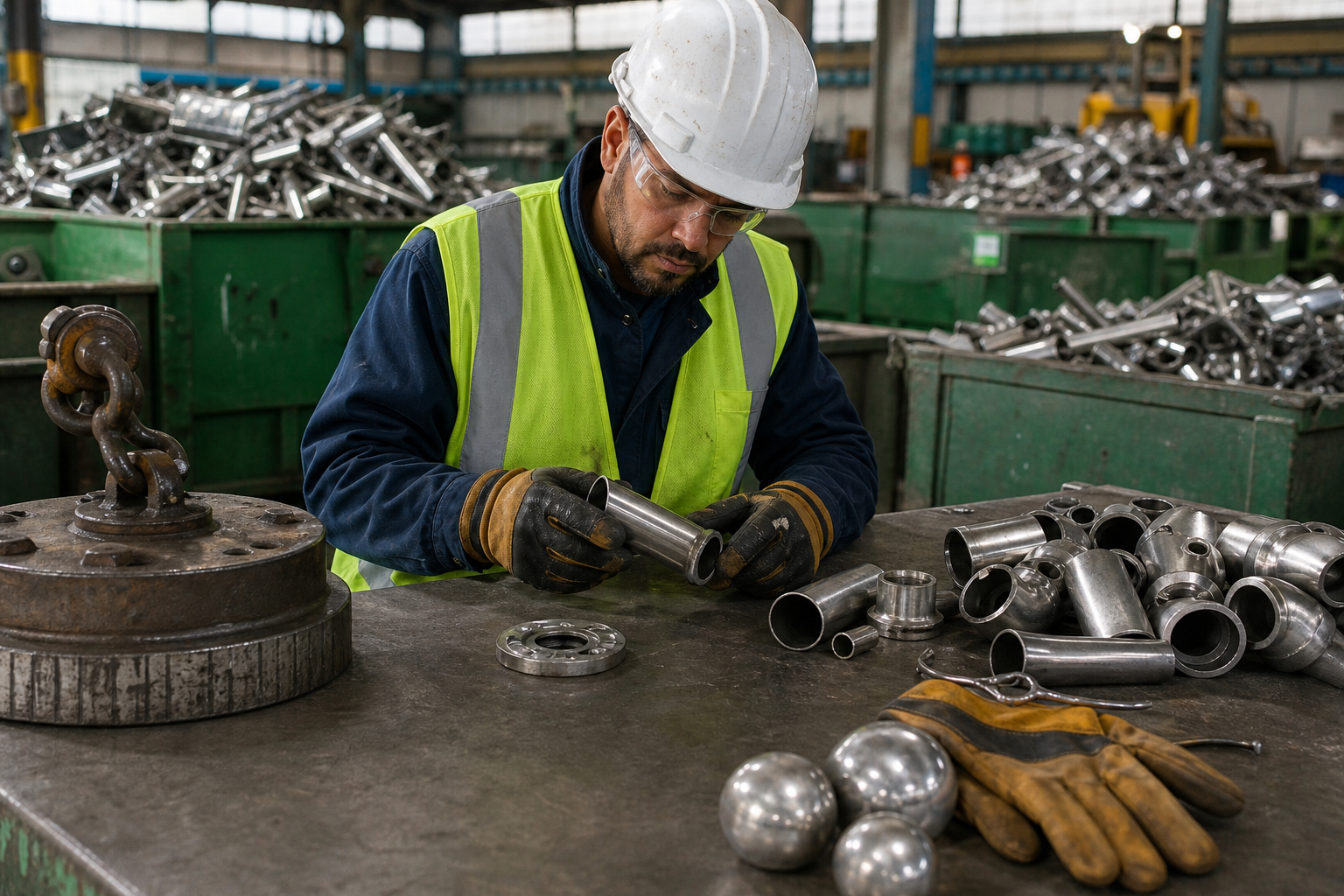
Identifying stainless steel grades at home is useful for preliminary sorting, but household checks cannot reliably prove an exact alloy. Markings, product information, surface inspection, and a cautious magnet test can help organize material into likely groups. Confirming whether a piece is 304, 316, 430, 409, or 410 requires calibrated alloy analysis or chemical testing.
That distinction matters when preparing scrap for sale or recycling. A homeowner may only need to separate clean stainless from mixed metal, while a contractor, fabricator, or business may need documented grade information before making a material or pricing decision. Research on rapid stainless-steel identification explains why comparison, group identification, and alloy analysis provide different levels of certainty.
What stainless steel grades and series mean
A stainless steel grade is a specific alloy composition and specification, not simply a description of how the metal looks. The number helps distinguish the proportions of elements such as chromium, nickel, carbon, and, in some grades, molybdenum. Two pieces can look almost identical while behaving differently in fabrication, corrosion resistance, or scrap sorting.
The 300-series and 400-series labels are useful broad categories, but they do not identify every piece of scrap. Many 300-series grades are associated with nickel-containing austenitic stainless steel. The 400 series includes ferritic and martensitic stainless steels, which often show stronger magnetic attraction. Processing can change the strength of that response.
For example, the supplied technical evidence identifies type 316 as a 300-series stainless steel containing approximately 2 to 3 percent molybdenum. That chemical difference cannot be confirmed by colour or a basic magnet test.
Common stainless steel grades compared

The table is a screening guide, not a substitute for alloy analysis. “Likely response” describes a clue, not a guaranteed result.
| Grade | Common examples | Likely magnet response | Identification caution |
|---|---|---|---|
| 304 | Kitchen equipment, sinks, food-service items, tanks, and general fabrication | Often weak or absent in ordinary sheet, though formed areas may respond differently | Appearance cannot separate 304 from similar 300-series grades |
| 316 | Marine, chemical, pharmaceutical, and higher-corrosion-exposure equipment | Often weak or absent, with possible variation after processing | Molybdenum content requires chemical or instrument analysis to verify |
| 430 | Appliance panels, decorative trim, kitchen equipment, and automotive details | Usually magnetic | Magnetism may suggest a 400-series family but does not prove 430 |
| 409 | Automotive exhaust components and heat-exposed fabricated parts | Usually magnetic | Exhaust parts may be coated, dirty, thin, or attached to other metals |
| 410 | Cutlery, tools, fasteners, valves, and wear-resistant components | Usually magnetic | It can resemble other magnetic stainless or alloy steels |
Use these descriptions to form a sorting hypothesis, not a guaranteed grade claim. A government salvage manual notes that magnetic material may belong to several different stainless-steel and alloy categories, so magnetism alone is not conclusive.
How to identify stainless steel scrap
1. Start with records and markings
Inspect the item, packaging, fabrication drawings, purchase records, and visible labels before cleaning or modifying anything. Look for markings such as “304,” “316,” “18-8,” “430,” or a manufacturer part number, but record them as evidence rather than absolute proof. A stamp can be incomplete, misplaced, or associated with only one component of a larger assembly.
2. Photograph the material
Photograph labels, welds, fasteners, fittings, and the original item. Note whether the piece came from a commercial kitchen, vehicle exhaust system, appliance, railing, or industrial installation. Source information can be more useful than a guess based only on colour.
3. Clean a small, safe area
Remove loose dirt or surface residue from a noncritical area without creating dust or damaging the item. Do not assume a shiny surface is a particular grade. Coatings, heat tint, oxidation, polishing, and residue can significantly change appearance.
4. Compare with a known sample
If you have a verified sample from the same product batch or documented installation, compare markings, finish, thickness, form, and magnet response. Comparison can support group identification, but similar-looking pieces are not necessarily the same alloy.
5. Perform a cautious magnet check
Use a small magnet on several clean areas. Record whether attraction is absent, weak, or strong, and note whether it changes near bends, welds, edges, or attached parts. Describe the result as “likely nonmagnetic,” “likely magnetic,” or “mixed response,” not as a grade certificate.
6. Label three practical groups
Divide the material into known, likely, and unknown groups. Put documented or traceable pieces in the known group, magnet-sorted or source-inferred pieces in the likely group, and mixed or uncertain material in the unknown group.
Why a magnet cannot prove a grade
A magnet detects magnetic behaviour, not complete chemical composition. Several stainless and alloy categories can attract a magnet, while some nominally nonmagnetic stainless can develop a measurable response after forming, welding, cold working, or other processing.
A strong attraction may help separate likely 400-series material from a nonmagnetic group, but it cannot distinguish 430 from 409 or 410 with confidence. A weak response does not prove that an item is 304 or 316. The magnet test is useful because it is quick and inexpensive, but it should not support a specific grade or price claim.
How to sort stainless steel scrap before recycling
Separate stainless from obvious non-stainless attachments where removal is safe and practical. Keep clean stainless pieces apart from carbon steel, aluminum, copper, insulated wire, plastic, and heavily contaminated material. Do not mix a documented 316 component with a load that only appears to be 300-series stainless.
Keep labels, photographs, purchase records, and notes with each batch. Record the source item, suspected grade or series, approximate quantity, magnet response, and attached materials. Clear separation makes it easier for a buyer to assess what is known and what needs verification. For additional preparation ideas, see this stainless steel scrap sorting guide.
Quick Scrap Metal buys and recycles stainless steel and other metals at 407 Rexdale Blvd in Etobicoke. The business also accepts scrap metal, appliances, and electronics, but assessment can depend on condition and attachments. If you have an unusual assembly, coated component, or uncertain load, describe it before assuming every part will be assessed as the same grade.
Safety precautions
Wear suitable gloves when handling sharp edges, cut sheet, wire, and damaged appliances. Keep loads stable during lifting and transport, and avoid reaching into crushed or tangled material where hidden edges, springs, or heavy components may shift.
Do not grind or cut stainless steel solely to identify it unless you have appropriate controls and experience. Grinding and cutting can create dust, sparks, heat, and sharp fragments. Unknown equipment may also contain oils, coatings, batteries, refrigerants, electrical components, or other attached materials requiring separate handling.
If inspection requires opening a sealed component, removing a battery, disturbing an unknown coating, or dismantling a heavy appliance, stop and ask the recycling yard or a qualified professional about a safer next step.
When professional alloy testing is worthwhile
Basic sorting is reasonable when the goal is to organize household scrap, remove obvious mixed metals, or give a yard a clearer description. You do not need to establish an exact grade merely to describe material as stainless steel of unknown or mixed composition.
Professional testing becomes more worthwhile when a grade distinction affects a large commercial load, fabrication specification, warranty, contract, or substantial pricing decision. It is also appropriate when records conflict, material is mixed, or the difference between suspected grades has important consequences.
Methods may include X-ray fluorescence (XRF), positive material identification (PMI), optical emission or spectrographic analysis, chemical analysis, or another calibrated alloy-analysis method. Ask which method suits the item and whether it can distinguish the grades being compared. Do not assume a scrap yard provides testing unless that service has been confirmed in advance.
What to tell a scrap yard
- What the material came from, such as a sink, appliance, exhaust part, railing, tank, or fabrication job.
- Any visible grade stamp, manufacturer label, invoice, drawing, or batch information.
- Whether the material is separated by suspected grade, source, or magnet response.
- Whether the load contains attachments, coatings, residue, insulation, batteries, or other metals.
- The approximate quantity and size or form of the pieces.
- Whether the grade is confirmed, likely based on records, or unknown.
If you are unsure, say so plainly. “Magnetic stainless from an exhaust system, not professionally tested” is more useful than claiming it is definitely 409 based only on appearance.
Stainless steel grade sorting checklist
- Inspect labels, stamps, records, and the original source.
- Photograph identifying details before dismantling anything.
- Clean only a safe, noncritical area.
- Use a magnet across several areas as a preliminary screen.
- Separate stainless from other metals and attachments where safe.
- Sort known, likely, and unknown material into labelled batches.
- Identify contaminated, coated, sharp, or hazardous components.
- Seek calibrated alloy testing when the exact grade affects an important decision.
- Tell the scrap yard what you know and what remains uncertain.
Frequently asked questions
Can a magnet tell me whether stainless steel is 304 or 316?
No. A magnet may show weak or absent response, but it cannot distinguish 304 from 316. Their difference depends on chemical composition, including the molybdenum associated with 316, so calibrated alloy analysis is needed for confirmation.
How can I identify 430 stainless steel from scrap?
430 is commonly magnetic, so a magnet and the item’s source can support a preliminary hypothesis. Other stainless and alloy steels can also be magnetic, so treat the material as likely 400-series or magnetic stainless until records or testing establish the exact grade.
Can colour or appearance identify a grade?
No. Polishing, oxidation, heat, coatings, dirt, and manufacturing finish can make different grades look alike. Appearance is useful evidence, but it is not conclusive.
Should unknown stainless be separated from confirmed grades?
Yes. Separate and label unknown material so it does not contaminate a batch supported by records or testing. Include the source and magnet response with the unknown group.
When is XRF or another professional test worth the cost?
Consider testing when the load is large, the exact grade affects a contract or fabrication decision, or a suspected grade would materially change the transaction. For a small household load, clear sorting and honest labelling may be more practical.
Can I bring mixed stainless-steel scrap to a recycling yard?
Ask the yard about mixed or unknown stainless, but do not assume it will be assessed as one confirmed grade. Separate what you can safely separate, retain your records, and explain the uncertainty when arranging drop-off.
Conclusion
The most reliable approach is layered. Start with records and markings, inspect the source and surface, use a magnet only to sort likely families, and keep known material separate from mixed or unknown scrap. Do not use a magnet, colour, appearance, or an isolated stamp as proof of an exact grade.
For routine recycling, organized and honestly labelled material is often enough to make the next conversation easier. When the grade matters to a significant commercial, fabrication, or specification decision, use calibrated alloy testing rather than relying on a household test.
For stainless-steel recycling and material-specific guidance, bring your prepared scrap to Quick Scrap Metal at 407 Rexdale Blvd in Etobicoke.