
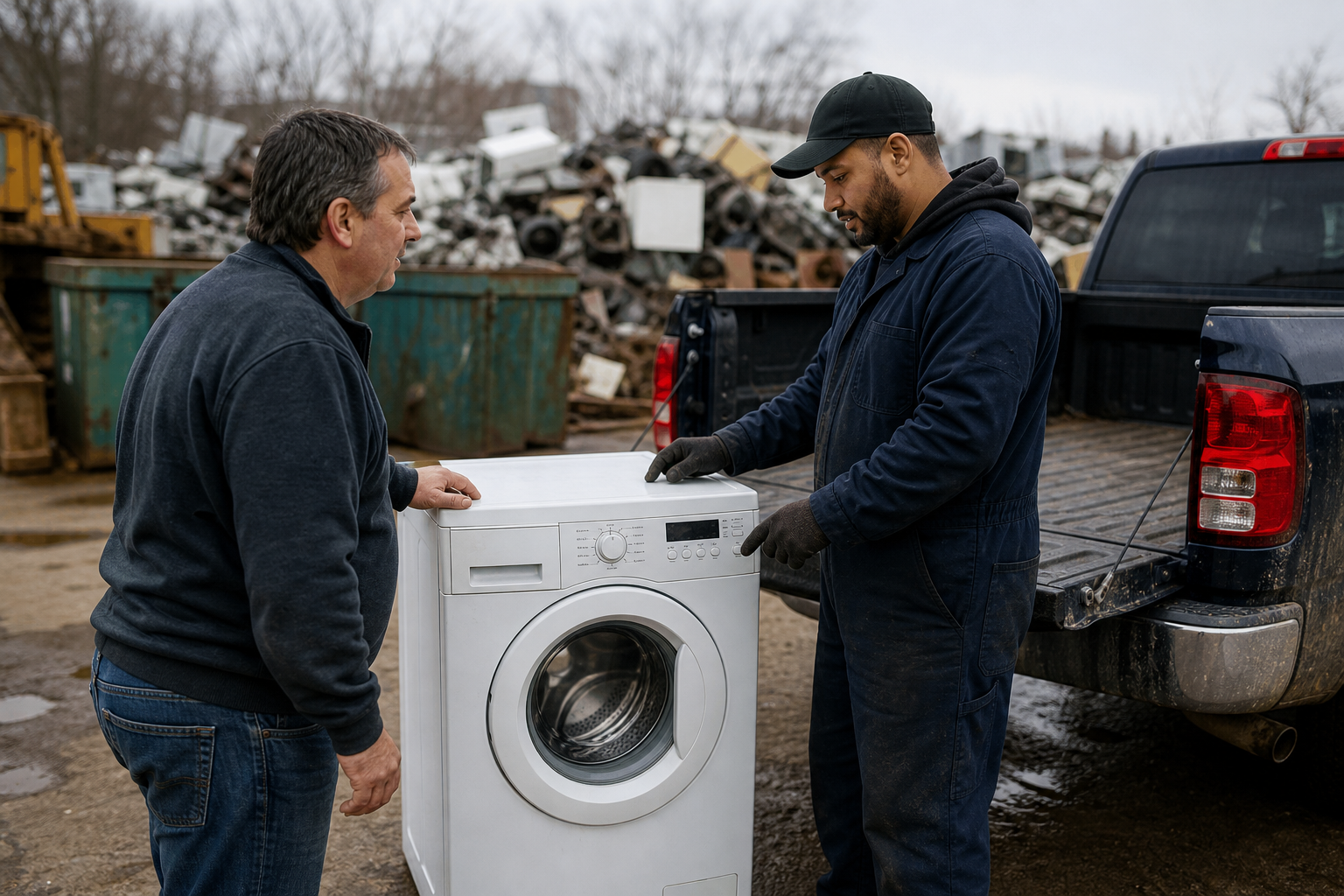
If you want to recycle old appliances for cash in Etobicoke, you may be able to bring qualifying items to Quick Scrap Metal at 407 Rexdale Blvd. The business accepts and recycles home appliances, describes cash payments for qualifying scrap, and serves residents, tradespeople, landlords, and businesses across Toronto and the GTA.
An appliance does not have a guaranteed fixed value. Acceptance and payment can depend on its weight, metal content, condition, recoverable components, and whether special handling is needed. Refrigerators, freezers, and air conditioners deserve particular attention because of their refrigerant systems.
Which old appliances may qualify for recycling and cash?
Quick Scrap Metal lists household appliances among the materials it recycles, including washers, dryers, dishwashers, microwaves, ovens, stoves, and air-conditioning units. It also handles other metal-bearing items such as motors, wiring, compressors, and steel components. You can review the business’s appliance recycling services before deciding what to bring.
Ontario regulations identify appliances such as air conditioners, clothes dryers, clothes washers, dishwashers, freezers, microwaves, refrigerators, and stoves within designated waste and recycling contexts. This supports using an appropriate recycling or waste-handling route rather than abandoning an appliance or placing it in an unsuitable collection stream. See Ontario’s definition of waste electrical and electronic equipment.
This list is a starting point, not a promise that every appliance will produce a payout. Before travelling, describe the item, its size, and any unusual features so the yard can explain whether it is suitable for drop-off and what information is needed to assess it.
Common appliances: what to ask about before loading them

| Appliance | Potential considerations | What to confirm |
|---|---|---|
| Washers and dryers | Steel body, motors, wiring, mixed materials, and overall weight | Whether the unit should arrive intact and whether a single unit can be dropped off |
| Dishwashers | Steel, wiring, pumps, insulation, and attached plastic | Whether loose parts should remain attached or be secured separately |
| Ovens and stoves | Steel, heating elements, wiring, glass, and size | How to transport the unit safely and whether removal help is available |
| Microwaves | Weight, wiring, mixed materials, and electronic components | Whether it is accepted as an appliance or should be handled as e-waste |
| Refrigerators and freezers | Steel, compressors, insulation, and refrigerant-related handling | Whether the yard accepts the unit in its current condition and how to transport it |
| Air conditioners | Metal, compressor, electrical parts, and refrigerant system | Current acceptance and special handling requirements |
Ontario also identifies refrigerators, freezers, stoves, ovens, washers, dryers, and dishwashers in specified recycling and waste-transfer contexts. That does not replace the yard’s acceptance process, but it reinforces the importance of using a proper recycling route for bulky household appliances. The relevant Ontario appliance recycling and waste-transfer regulation provides additional context.
Refrigerators, freezers, and air conditioners need extra confirmation
These appliances should not be treated as ordinary loose steel. Their cooling systems can contain refrigerant, and the equipment may require controlled handling before processing. Ask Quick Scrap Metal whether the specific unit can be accepted and whether it must remain intact.
Do not puncture, cut, drain, or attempt to remove refrigerant yourself. Improper dismantling can create safety and environmental risks and may affect whether the yard can accept the item. When asking for instructions, provide the appliance type, brand or model if available, approximate dimensions, and a photograph.
How to prepare an appliance before drop-off
Preparation should make the appliance safer to move and easier to assess. Avoid stripping components unless the yard specifically tells you that a part should be separated. For more local guidance, see how to prepare appliances for recycling in Etobicoke.
- Remove food, water, clothing, dishes, documents, and personal belongings.
- Empty drawers, shelves, filters, and compartments where loose items may remain.
- Secure doors, lids, shelves, cords, hoses, and detachable parts.
- Keep small components with the main appliance unless the yard advises otherwise.
- Do not dismantle compressors, cooling systems, electrical components, or pressurized parts.
- Measure bulky items and check that your vehicle can carry them without creating an unstable load.
- Use suitable lifting help and secure the appliance before driving. Do not attempt a lift beyond your equipment or ability.
- Photograph unusual, damaged, or oversized equipment before calling.
Drop-off or household removal: which option fits?
Drop-off may be simplest when you have manageable appliances, a suitable vehicle, and a safe way to load and unload them. It lets you bring the material directly to the Etobicoke yard for assessment, but you remain responsible for arranging safe transport.
Household removal or pickup may be more practical when an appliance is too large to move safely, several units need clearing, or you do not have a suitable vehicle. Quick Scrap Metal describes household scrap removal and pickup options for some materials, but availability, scheduling, fees, and eligibility should be confirmed for your situation.
Compare the transport effort, number of appliances, property access, and lifting requirements. This comparison of appliance pickup and removal options in Etobicoke can help you choose.
What affects the cash payment?
There is no reliable universal price for an old appliance. If the item qualifies, the payment may reflect total weight, recoverable metal, attached motors or wiring, condition, contamination, and the amount of non-metal material requiring handling.
Special handling can also affect the assessment. A refrigerator, freezer, or air conditioner may not be treated like a steel washer or stove because of its cooling system. Quantity may matter for contractors, landlords, or businesses clearing several appliances.
Quick Scrap Metal describes cash on the spot for qualifying scrap, but this should not be read as a guaranteed payout for every appliance. Ask how the specific unit will be assessed and whether the price is based on weight, material category, or another current yard rate.
Where to take old appliances in Etobicoke
Quick Scrap Metal is located at 407 Rexdale Blvd, Etobicoke, ON M9W 6P8, near Highway 27 and Rexdale. The business serves Etobicoke, Toronto, Mississauga, Brampton, and the broader GTA, offering a local option for combining appliance recycling with other scrap-metal drop-off.
The business promotes Sunday opening and later weekday availability. Confirm current hours and appliance requirements before loading a large or refrigerant-containing unit.
Before you go: a confirmation checklist
- Appliance type, brand, model, dimensions, and estimated weight.
- Whether it is complete, damaged, leaking, unusually heavy, or missing major parts.
- Whether it contains a compressor or cooling system.
- Number of units and their location.
- Whether you plan to drop off the appliance or need removal.
- Current acceptance and whether the appliance should remain intact.
- How payment is determined and whether the item is expected to qualify.
- Current hours and any identification, paperwork, vehicle, or access requirements.
A useful question is: “I have a complete [appliance type], approximately [size], and I want to drop it off for recycling. Do you accept it, how should I transport it, and how is payment assessed?”
FAQ
Can I recycle a refrigerator or freezer for cash in Etobicoke?
You can ask about recycling a refrigerator or freezer and possible payment, but acceptance and payout are not automatic. These units may require special handling, so confirm requirements before moving one.
Does an old appliance have to work to qualify for payment?
Not necessarily. Scrap value can come from metal and recoverable components rather than operation. Condition, completeness, weight, and handling requirements can still affect acceptance and payment.
Will every old appliance earn cash?
No. A yard may accept an appliance for recycling without every item receiving the same payment basis. Some items may require special handling or prior confirmation.
Should I call before bringing an air conditioner?
Yes. Confirm acceptance and transport instructions before bringing an air conditioner, refrigerator, or freezer. Do not remove refrigerant or dismantle the cooling system yourself.
Is appliance pickup available if I cannot transport the item?
Quick Scrap Metal describes household scrap removal and pickup options for some materials. Provide the appliance type, quantity, location, access conditions, and preferred timing when asking whether removal can be arranged.
Conclusion: confirm first, then recycle safely
Identify the appliance, remove loose contents, secure it for transport, and confirm acceptance before loading. Washers, dryers, dishwashers, microwaves, ovens, and stoves can be discussed as household scrap, while refrigerators, freezers, and air conditioners need extra confirmation because of refrigerant-related handling.
Choose drop-off when you have a safe vehicle and manageable load. Ask about removal or pickup when the appliance is bulky, access is difficult, or moving it yourself would be unsafe. Treat cash as possible payment for qualifying scrap, not a guaranteed price.
Before bringing an appliance to 407 Rexdale Blvd, confirm current hours, acceptance requirements, payment basis, and transport instructions with Quick Scrap Metal.