
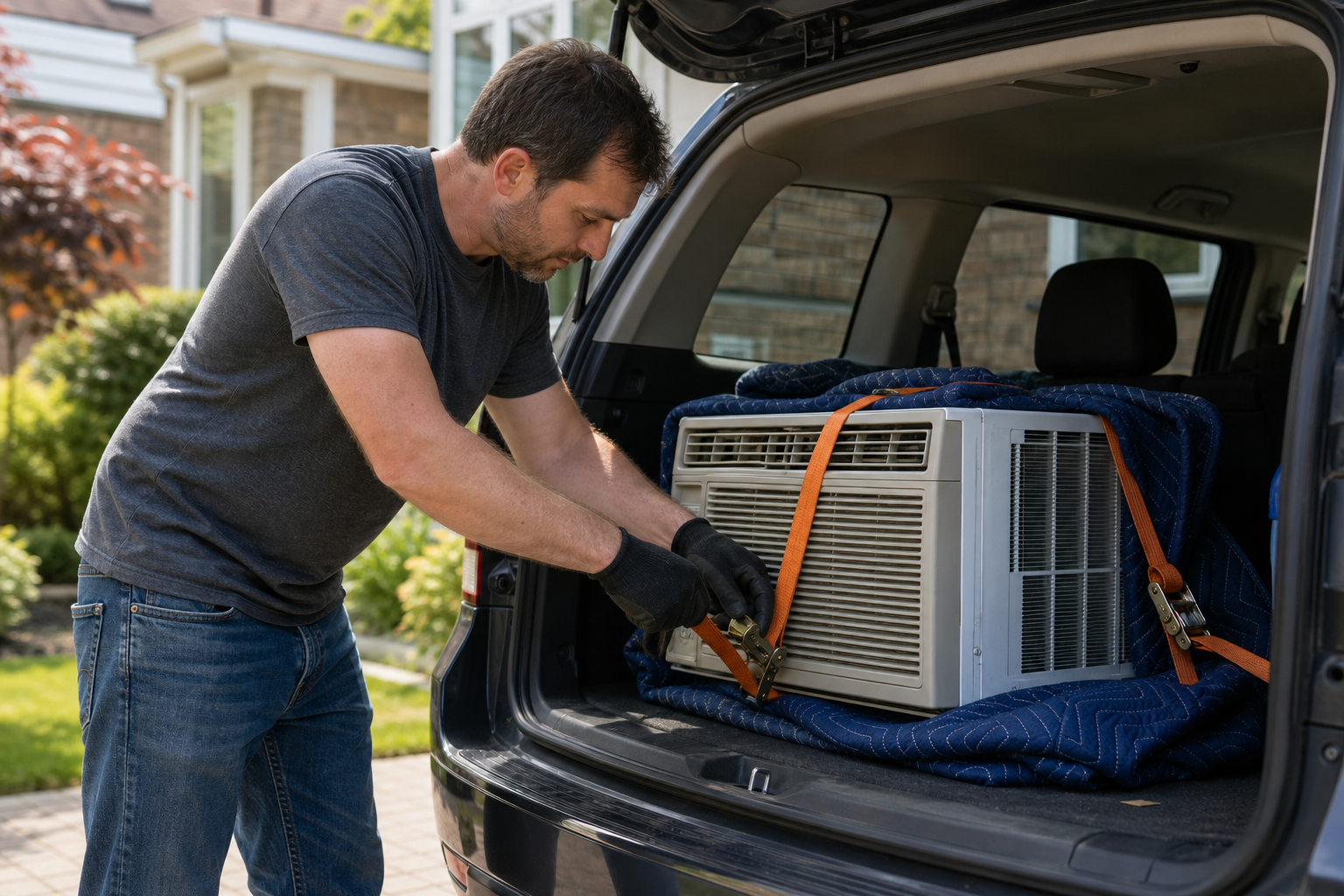
Recycling an old air conditioner in Etobicoke starts with one important rule: keep the unit intact and do not release or remove its refrigerant yourself. An A/C unit may contain recyclable metal and other recoverable materials, but the sealed refrigeration system requires specialized handling under Ontario rules.
The safest process is to identify the unit, confirm that the receiving facility accepts its type and condition, disconnect it from power, and arrange transport or pickup without cutting lines, puncturing coils, or opening the compressor. This guide explains how to prepare window, portable, and larger A/C equipment for a responsible recycling route.
Quick summary

- Keep an intact A/C unit sealed. Never vent, drain, cut, or puncture the refrigerant system.
- Disconnect power and remove only loose, non-system accessories that can be taken off safely.
- Confirm acceptance, refrigerant requirements, transport rules, hours, and payment before loading the unit.
- Use a suitable vehicle, straps, and protective padding. Arrange pickup if the equipment is too heavy or awkward to move safely.
- Quick Scrap Metal lists A/C units among its accepted materials, but unit type, condition, and current requirements should be confirmed before visiting.
Choose the right recycling route before moving the unit
The best route depends on the equipment you have and whether it is still an intact refrigeration appliance. A small window unit, a portable air conditioner, and an outdoor central A/C condenser may all contain recyclable metal, but they differ substantially in weight, handling needs, and transport risk.
| What you have | Practical next step | What to confirm |
|---|---|---|
| Intact window A/C | Keep it sealed and ask about drop-off requirements. | Whether that model and size are accepted, how it should be positioned, and whether payment applies. |
| Portable A/C | Disconnect it, retain the unit and hose together, and confirm acceptance. | Whether the facility accepts portable units and accessories as one load. |
| Central A/C condenser or larger equipment | Use professional removal or arrange a suitable pickup if it is connected, heavy, or difficult to load. | Whether the unit must be professionally decommissioned before delivery. |
| Professionally decommissioned equipment | Keep any service documentation and ask how the facility wants the equipment delivered. | Whether proof of refrigerant recovery or other information is required. |
| Unsafe or immovable equipment | Do not force, dismantle, or drag it through a home or commercial space. | Whether pickup is available or whether an HVAC professional should handle removal. |
Toronto’s public disposal guidance identifies the Disco Road depot in Etobicoke, but the available information does not establish that every residential A/C model is accepted there. Treat municipal disposal as an option to verify, not an automatic answer for every unit.
A/C recycling options in Etobicoke

Scrap-yard drop-off
A scrap yard can be convenient when you have a removable appliance, a suitable vehicle, and other recyclable materials to bring at the same time. Quick Scrap Metal is located at 407 Rexdale Blvd in Etobicoke and lists A/C units, compressors, appliances, ferrous metals, and non-ferrous metals among its accepted materials.
Before loading, ask whether the unit should arrive intact, whether a particular model requires prior professional refrigerant recovery, and how staff assess the appliance. A scrap yard may assess or weigh eligible material, but acceptance and payment can depend on the unit’s condition, composition, and current requirements. For broader context on A/C units and scrap yard prices, review the current pricing information before you make the trip.
Arranged pickup
Pickup is usually the more practical choice for a large outdoor condenser, multiple appliances, a basement installation, or equipment that cannot be loaded without lifting risks. Do not assume that pickup is available for every A/C unit. Confirm the service area, access requirements, loading method, and whether the unit must be disconnected by an HVAC professional.
Municipal or authorized disposal
A municipal depot or another authorized disposal program may be appropriate when the priority is disposal rather than payment. Requirements can vary by equipment type, residency, quantity, and whether the unit contains refrigerant, so check the current instructions before transporting it.
HVAC professional removal
An HVAC contractor is the appropriate first call when the equipment is still installed, connected to refrigerant lines, or part of a larger central system. Ask the contractor what documentation will be provided after refrigerant recovery and whether they can transport the decommissioned equipment to an authorized recycling route.
Refrigerant safety: what you must not do
Refrigerant handling is not ordinary scrap preparation. Ontario states that a certified technician with an Ozone Depletion Prevention certificate is required to remove, discharge, handle, and dispose of relevant refrigerants. See the Ontario requirements for handling refrigerants before working on equipment that may still contain a charge.
Do not cut copper lines, puncture coils, open the compressor, drill into the casing, or use a tool to “empty” the unit. Ontario prohibits releasing refrigerants into the air, and its regulations set requirements for refrigeration equipment and refrigerant waste. Refrigerant can also escape from equipment that appears old, damaged, or empty.
Do not dismantle or dispose of refrigeration equipment as ordinary scrap unless the required notices and authorized methods have been followed. Ontario’s rules specifically restrict recycling or disposing of refrigeration equipment that contains refrigerant unless it is handled through an authorized process. The safest homeowner action is to leave the sealed system alone and ask a qualified professional or receiving facility what must happen next.
This distinction matters even if your goal is to recover valuable copper or aluminum. Removing a casing or detachable panel may be acceptable in some circumstances, but accessing the sealed system is a different task. If you are unsure whether a part is part of that system, leave it in place.
How to prepare an A/C unit for recycling
Preparation should make the unit safer to transport without interfering with the refrigeration circuit. Follow this sequence:
- Identify the equipment. Note whether it is a window unit, portable unit, outdoor condenser, heat-pump component, or another type of air-conditioning equipment. Record the make and model if it is easy to find.
- Disconnect power. Unplug a portable or window unit when it is safe to do so. For hard-wired or installed equipment, have the appropriate professional disconnect it.
- Keep the sealed system intact. Do not remove refrigerant, cut lines, or dismantle the compressor, coils, valves, or connected tubing.
- Secure loose accessories. Keep remote controls, hoses, brackets, panels, and power cords with the unit where practical. Remove only items that are loose and safe to detach, and ask the receiving facility whether they want them included.
- Protect the equipment. Keep the unit dry and cover sharp edges or loose pieces with suitable padding. Avoid wrapping it so tightly that staff cannot inspect it.
- Check for leaks or damage. If you see oil, hear hissing, smell an unusual chemical odour, or see a damaged coil or line, do not handle the unit unnecessarily. Tell the facility or an HVAC professional about the condition.
- Confirm the route. Call or message before loading so you know whether the facility accepts the exact unit, requires professional decommissioning, offers pickup, or has special loading instructions.
Quick Scrap Metal also publishes general guidance on preparing appliances for recycling safely. Use that information alongside the specific instructions you receive for your A/C equipment, because refrigerant-containing appliances need extra care.
Transport the unit safely
Choose transport based on the unit’s weight, shape, and condition. A small window unit may fit in a vehicle with padding and straps, while a large condenser may require a truck, ramp, lifting equipment, or professional pickup.
- Use a vehicle with enough capacity to prevent the unit from shifting or being crushed.
- Secure the appliance with straps and padding, especially around coils, corners, and control panels.
- Keep it upright where practical and follow the receiving facility’s instructions if it must be transported in another position.
- Do not stack heavy objects on top of the unit or place tools where they can puncture the casing.
- Use a second person, dolly, ramp, or professional help instead of lifting beyond your ability.
- Keep children and passengers away from unsecured equipment during transport.
If the unit is still mounted in a window, attached to a wall, connected to refrigerant lines, or located where removal could cause injury, do not turn a recycling trip into a demolition project. Arrange qualified removal first.
What happens at a scrap yard
At a scrap yard, the receiving process generally begins with confirming what you brought and whether it fits the facility’s current acceptance requirements. Staff may inspect the unit’s condition, identify its material category, and determine whether it can enter the appropriate appliance or metal recycling stream.
Eligible material may then be assessed or weighed according to the yard’s process. Payment, when offered, depends on the material, condition, grading, and current rate. Quick Scrap Metal describes cash-on-the-spot payments for qualifying materials, but you should confirm whether your specific A/C unit qualifies and how it will be assessed before visiting.
The yard may direct the appliance to downstream processing rather than treating it like clean, loose copper or aluminum. That is why an intact unit should be presented honestly as an A/C appliance, not dismantled or described as ordinary scrap after its sealed system has been disturbed.
What to confirm before visiting Quick Scrap Metal
Quick Scrap Metal lists A/C units among its accepted materials and operates at 407 Rexdale Blvd, Etobicoke, near Highway 27 and Rexdale. Its published hours are Monday through Friday from 8:00 a.m. to 7:00 p.m., Saturday from 8:00 a.m. to 5:00 p.m., and Sunday from 9:00 a.m. to 5:00 p.m. Hours and acceptance requirements can change, so confirm them before setting out.
When you contact the yard about an A/C unit, have these details ready:
- Unit type: window, portable, outdoor condenser, central system component, or another model.
- Approximate dimensions and weight, if known.
- Whether it is intact, damaged, installed, or professionally decommissioned.
- Whether refrigerant recovery has been completed by a qualified professional.
- Whether drop-off is preferred or pickup may be available.
- Whether the unit should be transported upright and whether loading assistance is provided.
- Whether payment is available for that category and what identification or documentation is needed.
- Whether other appliances, metals, or electronics can be included in the same visit.
Etobicoke A/C recycling checklist
- Identify the unit and photograph its label if useful.
- Do not vent, drain, cut, puncture, or dismantle the sealed refrigeration system.
- Disconnect power only when it is safe and appropriate.
- Keep hoses, cords, brackets, panels, and loose parts together.
- Keep the appliance dry and protect it from movement during transport.
- Confirm acceptance and refrigerant requirements before loading.
- Verify drop-off or pickup, loading instructions, hours, and payment expectations.
- Use professional removal for installed, hard-wired, leaking, very heavy, or inaccessible equipment.
Frequently asked questions
Can I recycle an intact window air conditioner in Etobicoke?
Possibly. Keep it intact and contact the receiving facility with the model, approximate size, and refrigerant status. Quick Scrap Metal lists A/C units among its accepted materials, but you should confirm that your specific unit can be dropped off and whether any preparation or payment conditions apply.
Can I drop off a portable air conditioner without removing the refrigerant?
Do not remove the refrigerant yourself. Keep the portable unit sealed, disconnect it from power, retain its hose and accessories, and ask the facility whether that model is accepted in its current condition.
What should I do with a central A/C unit or outdoor condenser?
If it is connected, hard-wired, installed, or too heavy to move safely, arrange removal by an HVAC professional or ask about a suitable pickup. Confirm whether refrigerant recovery or documentation is required before taking the condenser to a scrap yard.
Can I remove refrigerant from an A/C unit myself before recycling it?
No. Ontario requires certified expertise for relevant refrigerant removal, discharge, handling, and disposal. Do not cut lines or puncture the unit. Leave the sealed system intact and use a qualified technician or an authorized receiving route.
Should I call Quick Scrap Metal before bringing an A/C unit?
Yes. A call or message can confirm the unit type, intact or decommissioned status, drop-off or pickup options, hours, loading expectations, and whether payment applies. This is especially important for large condensers, damaged equipment, and units that are still installed.
Conclusion: confirm first and keep the unit intact
Responsible A/C unit recycling in Etobicoke is straightforward when you separate ordinary appliance preparation from refrigerant work. Keep the unit sealed, disconnect power safely, protect it during transport, and never release or remove refrigerant without certified professional handling.
The right route may be a confirmed scrap-yard drop-off, an arranged pickup, a municipal option, or HVAC-assisted removal. Because acceptance, transport requirements, payment, and refrigerant status vary by unit, confirm the details before you load the appliance. For current A/C acceptance and drop-off information at 407 Rexdale Blvd, contact Quick Scrap Metal before visiting.