
Last updated: October 2026
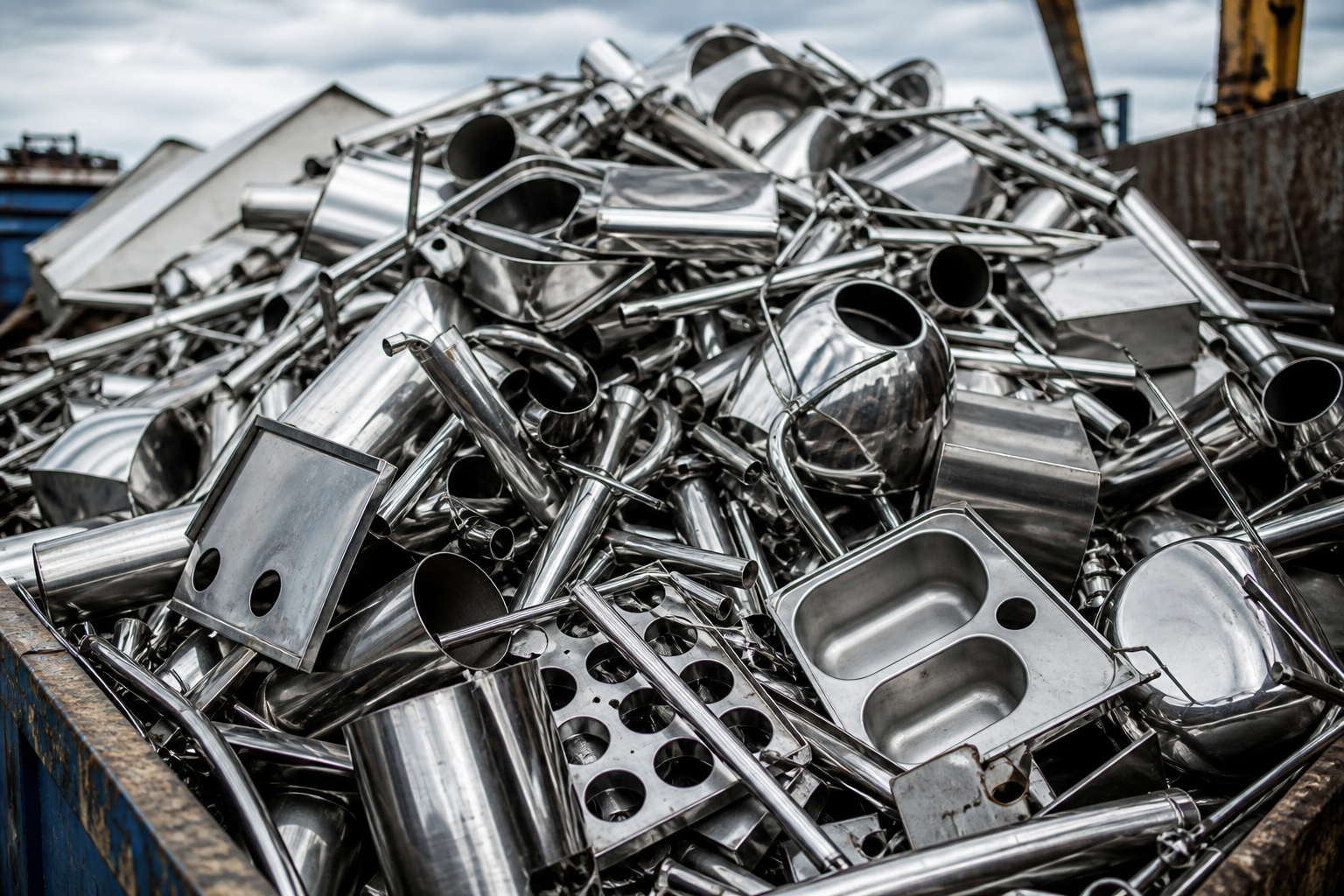
If you are clearing sinks, restaurant equipment, pipe, appliances, fabrication offcuts, or production scrap, the grade of the stainless is only the starting point. A buyer also has to account for attached carbon steel, plastic, oil, moisture, sorting time, transportation, and the value of the recovered alloy content.
This scrap stainless steel prices guide explains how yards evaluate material, what the common grades look like, why published prices can differ, and how to prepare a load before you sell. It is designed for household sellers, contractors, fabricators, maintenance teams, and businesses bringing stainless to a local scrap yard in Etobicoke, Toronto, Mississauga, Brampton, or the broader GTA.
Current scrap stainless steel prices in Etobicoke
Published local listings illustrate why a seller should treat an online figure as a reference rather than a guaranteed offer. One recent listing associated with Quick Scrap Metal reported stainless steel 304 at $0.59 per pound, updated October 29, 2026. Other Etobicoke market listings reported 304 at $0.67 USD per pound and 316 at $1.45 USD per pound on October 23, 2026.
These figures should not be compared as though they were one unified price sheet. They differ in currency, date, source, grade category, averaging method, and payment basis. A listing may represent an average across yards, while an individual buyer’s offer can change with the load’s cleanliness, quantity, testing result, and handling requirements.
| Published reference | Reported figure | Important qualification |
|---|---|---|
| Local Quick Scrap Metal listing | 304 stainless: $0.59/lb | Reported October 29, 2026; verify the current offer directly. |
| Etobicoke market listing | 304 stainless: $0.67 USD/lb | Reported October 23, 2026; market listing, not a guaranteed individual quote. |
| Etobicoke market listing | 316 stainless: $1.45 USD/lb | Reported October 23, 2026; grade and currency differ from the 304 references. |
The practical lesson is to ask four questions before loading your vehicle: Which grade or category does the buyer expect? Is the quoted amount in Canadian or U.S. dollars? Is the price for clean solids, mixed stainless, turnings, or another category? Will attached material or contamination affect the payable weight?

What factors affect scrap stainless steel prices?
Stainless steel is valuable as scrap because its alloy content can be recovered and used again. The price a yard can pay depends on the expected value of that material after inspection, sorting, processing, transportation, and sale to a downstream processor.
Grade chemistry
304 and 316 are both common austenitic stainless grades, but they do not have identical chemistry. Grade 316 is associated with molybdenum-bearing chemistry and applications requiring greater resistance to certain corrosive environments. That difference can create a meaningful spread between properly identified 304 and 316 material.
Ferritic grades such as 409 and 430 are also stainless, but their alloy content and typical applications differ. A buyer therefore cannot price every bright or silver-coloured item as one uniform product. Accurate identification protects the value of a higher-grade lot and prevents a mixed load from being treated as an uncertain category.
Cleanliness and attachments
A stainless table with a small number of removable fasteners is not the same as a stainless appliance containing insulation, wiring, plastic, a carbon-steel frame, and a compressor. Non-stainless weight increases sorting and disposal work, and some residues create handling or environmental concerns.
Paint, rubber, gaskets, food residue, oil, coolant, soil, and moisture can all affect the buyer’s assessment. Removing practical, safe-to-remove attachments before delivery gives the grader a clearer lot and reduces the possibility of a contamination deduction.
Solid material versus turnings
Solid sheet, tubing, plate, fittings, and cutoffs are usually easier to inspect and process than chips or turnings. Turnings have a high surface area, may retain cutting fluid, can oxidize, and may contain fines or material from more than one grade. They need appropriate containers and may be assigned a separate category.
Never pour oily turnings into an open passenger compartment or an unsuitable container. Keep them as dry as practical, identify the likely grade, and ask the buyer about accepted containers before transport.
Size, density, and handling
Large tanks, long lengths of pipe, tangled wire, and irregular equipment may require additional shearing, cutting, lifting, or sorting. Dense, manageable pieces are easier to weigh and move. However, cutting should only be done when it is safe and permitted, particularly where pressure vessels, refrigerants, electrical components, sharp edges, or unknown residues are involved.
Quantity and consistency
A uniform lot gives a buyer more confidence than a small bucket containing several grades. Larger quantities do not automatically guarantee a higher rate, but consistent material can be tested and categorized more efficiently. Keep known 304, known 316, ferritic stainless, turnings, and unknown pieces in separate containers whenever possible.
Market conditions and logistics
Scrap values move as mills, processors, alloy markets, freight costs, and regional demand change. A buyer also considers the cost of moving your material from the yard to its next destination. This is why a price seen online on one date may not match a quote on another date, even when the material description appears similar.
How to identify common stainless steel grades
Grade identification is useful, but a field check is not a substitute for professional testing. Use several clues together and do not represent an uncertain grade as confirmed. If documentation and markings disagree with a visual or magnet test, set the material aside for verification.
304 stainless steel
Grade 304 is widely used in sinks, commercial kitchen equipment, food-service surfaces, handrails, tanks, tubing, architectural trim, and general fabrication. It is often described as an 18/8 austenitic stainless grade. Most bulk 304 is non-magnetic, although cold forming, grinding, or welding can produce some magnetic response.
316 stainless steel
Grade 316 appears in marine fittings, chemical-processing equipment, sanitary piping, pharmaceutical environments, and other applications where additional corrosion resistance is needed. It can look almost identical to 304, so appearance alone cannot establish the grade. Look for markings such as 316 or 316L, retain mill documentation, or request testing from the buyer.
201 and 202 stainless steel
Grades 201 and 202 are manganese-substituted austenitic grades used in some lower-cost consumer and fabricated products. They may show a slight magnetic response and can behave differently from 304 in corrosive service. Do not assume that a weak magnet pull means 304 or 316.
409 and 430 stainless steel
Ferritic grades such as 409 and 430 are commonly associated with automotive exhaust components, appliance panels, and other applications where magnetic stainless is suitable. They usually attract a magnet more strongly than 304 or 316. Grade 409 can develop surface rust in service, which does not automatically mean that it is ordinary carbon steel.
Precipitation-hardened and specialty grades
Grades such as 17-4 PH can occur in high-strength, aerospace, medical, and industrial components. These materials may be magnetic and require precise identification. If the lot comes from a documented industrial source, keep part numbers, material certificates, drawings, and labels with it.
Useful field checks
- Magnet: A strong attraction suggests ferritic, martensitic, precipitation-hardened, or carbon steel material, but it does not identify one exact grade.
- Stamp or marking: Look for 304, 304L, 316, 316L, 430, 409, or a manufacturer’s material designation on flanges, pipe, fittings, and cutoffs.
- Documentation: Mill certificates, purchase records, part drawings, and supplier invoices may support the identification.
- Professional testing: A buyer may use a handheld alloy analyzer or another verification method when the grade affects the category.
Never use a grinder or spark test casually around flammable residues, pressurized equipment, or unknown coatings. If the material’s history is unclear, keep it in an “unknown stainless” group rather than contaminating a verified higher-value lot.
How to prepare stainless steel before selling
Preparation should improve identification and handling without creating a safety hazard. The goal is not to dismantle every item at any cost; it is to remove practical contamination, preserve evidence of grade, and present the material in categories a buyer can inspect.
Separate grades and forms
Place known 304, known 316, magnetic ferritic stainless, and unknown pieces in different bins or bundles. Keep solid material separate from turnings and chips. Do not mix a small amount of uncertain or lower-grade material into a large clean lot simply to save space.
Remove non-stainless attachments
Where safe, remove carbon-steel brackets, bolts, hinges, frames, wood, plastic liners, rubber feet, insulation, wiring, and other non-metal parts. Stainless restaurant tables may have stainless tops but carbon-steel legs or cross-braces. Stainless appliance skins may be attached to a steel cabinet and surrounded by plastics and electrical components.
Drain and clean equipment
Drain tanks, vessels, machinery, and containers of oil, coolant, food residue, and other liquids. Wipe accessible residue and keep wet or oily material away from clean solids. Do not open, cut, puncture, or dismantle equipment that may contain refrigerant, pressurized contents, hazardous chemicals, batteries, or unknown substances.
Make oversized items manageable
Ask the buyer about acceptable dimensions before cutting long pipe, plate, tanks, or equipment. If preparation is appropriate, use safe methods and proper protective equipment. Sharp edges should be controlled, and bundles should not be so heavy or unstable that they create a lifting risk.
Bundle and label clearly
Bundle uniform tubing and similar offcuts so they can be moved safely. Use labels such as “304 sink cutoffs,” “316 pipe offcuts,” or “unknown stainless – needs testing.” A photograph of a grade stamp can help preserve information, but it should not replace physical inspection of the lot.
How scrap yards typically grade and pay
The exact process varies by buyer, but a typical transaction starts with an inspection of the material and its attachments. Staff may use a magnet, examine markings, review paperwork, and use an analyzer where available. The load is then assigned to a category that reflects its grade, form, cleanliness, and expected processing cost.
Inspection and category assignment
Possible categories include clean 304 solids, clean 316 solids, ferritic stainless, mixed stainless, stainless with attachments, and stainless turnings. A category is not determined by colour alone. The buyer must consider whether the material is actually stainless, whether grades are mixed, and whether the lot contains enough contamination to change its classification.
Weight and deductions
Payment is generally based on an accepted weight multiplied by the current category rate. Non-metal attachments, moisture, oil, and other unwanted material may reduce the payable weight or affect the category. Ask whether the displayed weight is gross, tare, or net, and request a scale ticket or transaction record.
Questions to ask before unloading
- What stainless categories are currently being purchased?
- Do you accept 304 and 316 separately?
- How are turnings, chips, appliances, or stainless with attachments handled?
- Is the quoted rate in Canadian dollars, and is it per pound or another unit?
- Can separated lots be weighed and recorded individually?
- Are there restrictions on oily, wet, sharp, oversized, or potentially hazardous items?
Calling before a large delivery can prevent an unnecessary trip and helps you learn whether the material should be prepared differently. A buyer may also advise whether a pickup or drop-off is more suitable for the quantity and equipment involved.
Seller checklist for better stainless scrap results
Use this checklist before leaving for the yard:
- Look for grade stamps, labels, certificates, invoices, or part records.
- Use a magnet as an initial clue, not as proof of 304, 316, or any other exact grade.
- Separate 304, 316, ferritic stainless, turnings, and unknown pieces.
- Remove safe-to-remove bolts, brackets, plastic, rubber, insulation, wood, and carbon-steel frames.
- Drain and wipe equipment while avoiding unsafe dismantling of sealed or hazardous components.
- Bundle uniform shapes and control sharp edges.
- Label every container or bundle with the suspected grade and material type.
- Keep oily turnings in suitable, secure, drainable containers.
- Take photographs of useful markings and bring supporting paperwork.
- Ask for the current category, unit, currency, and any expected deductions.
- Request separate weights for clearly separated categories.
- Bring identification and secure every load for transport.
Common mistakes that reduce value
Mixing 304 and 316 is one of the most avoidable mistakes because it removes confidence in the higher-value identification. Another is assuming that every non-magnetic piece is 316; 304 can also be non-magnetic, while cold-worked material can develop a weak pull.
Leaving a carbon-steel frame attached, bringing oily turnings in an open container, or delivering tangled wire can increase handling costs. Sellers should also avoid chasing an online “highest price” without checking the date, currency, grade, and material assumptions behind it.
Frequently asked questions about scrap stainless steel prices
What are scrap stainless steel prices today?
There is no single universal rate because the offer depends on grade, cleanliness, form, quantity, location, and the buyer’s current market conditions. Recent Etobicoke references reported 304 at $0.59 per pound in one local listing and $0.67 USD per pound in another market listing, while a separate listing reported 316 at $1.45 USD per pound. Those figures use different sources and currencies, so confirm the current Canadian-dollar category rate directly before delivery.
Is 316 stainless steel worth more than 304?
316 is often priced differently from 304 because its chemistry includes alloying content associated with improved corrosion resistance in demanding applications. The exact difference changes with market conditions and buyer categories. Do not rely on appearance or a magnet alone; use markings, documents, or professional testing to support the grade.
Can a magnet identify stainless steel grades?
No. A magnet is a useful sorting clue, but it cannot reliably distinguish 304 from 316 and cannot prove that magnetic material is a particular stainless grade. Cold working may create a slight pull in austenitic stainless, while ferritic, martensitic, precipitation-hardened, and carbon-steel materials may attract a magnet more strongly.
How should I prepare stainless appliances for a scrap yard?
Separate stainless panels or components from carbon-steel frames and other materials only when doing so is safe and permitted. Remove accessible plastic, rubber, insulation, and attachments, but do not puncture or dismantle sealed refrigeration systems, pressurized vessels, batteries, or equipment containing unknown substances. Ask the buyer whether the item should be delivered as an appliance or as separated stainless components.
Are stainless turnings priced differently from solid scrap?
Often, yes. Turnings and chips can contain oil, moisture, fines, oxidation, and mixed material, and they require different handling from clean solid pieces. Keep them segregated by suspected grade, as dry and clean as practical, and in containers accepted by the buyer.
What should I ask before selling stainless scrap?
Ask which categories the buyer accepts, whether 304 and 316 are purchased separately, what unit and currency apply, and how contamination or attachments affect the offer. Also ask whether separate lots can receive separate weights and whether your load has any size, safety, or transport restrictions.
Get a current local assessment
For a current assessment of your stainless material, contact Quick Scrap Metal before you load a large or uncertain delivery. Provide the likely grade, form, approximate quantity, attachments, and location so the team can explain the appropriate next step.