
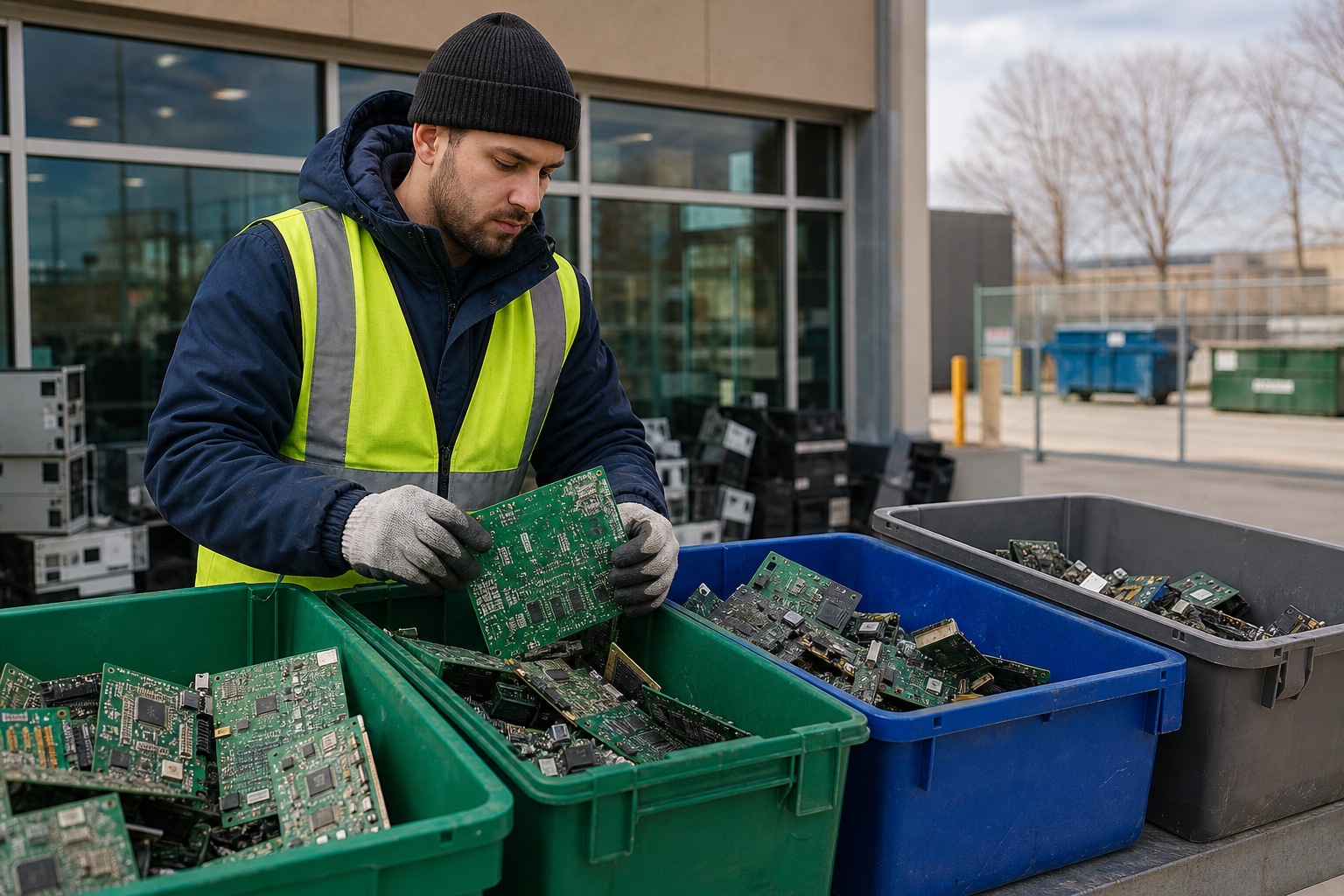
Most printed circuit boards removed from computers, televisions, Blu-ray players, keyboards, and similar electronics should go through an e-waste or qualified electronics-recycling route rather than household garbage. The important exception is equipment suspected of containing polychlorinated biphenyls, also called PCBs. That equipment must not be sent to an ordinary scrap-metal recycler and requires authorized hazardous-waste guidance.
This guide explains how to identify the material, choose the right recycling route, prepare boards or complete devices, protect your data, and confirm acceptance before travelling to a Toronto or GTA drop-off location.
Quick summary

- Keep ordinary circuit boards with their original electronics when practical, and confirm whether a recycler accepts loose boards.
- Do not burn boards, place them in household garbage, or dismantle unknown industrial equipment.
- Remove and handle batteries separately only when it is safe and appropriate. Protect personal data before recycling computers and storage devices.
- Do not confuse printed circuit boards with polychlorinated biphenyl contamination. Suspected PCB-containing transformers, capacitors, and lamp ballasts require authorized hazardous-waste handling.
- Before visiting, describe the item, ask about current acceptance requirements, and verify the location’s hours.
What printed circuit boards are and where you find them
A printed circuit board is a rigid or flexible panel that connects electronic components through conductive pathways. It is the board inside many devices that allows chips, connectors, switches, and other components to communicate and receive power.
You may find circuit boards in desktop computers, laptops, televisions, Blu-ray players, keyboards, monitors, appliances, audio equipment, control panels, and other electronic devices. Quick Scrap Metal specifically lists computers, televisions, Blu-ray players, keyboards, and printed circuit boards among the electronics it accepts for recycling at its Etobicoke location. That does not mean every board or industrial component is automatically accepted, so describe unusual material before loading your vehicle.
A board’s appearance does not tell you its exact value or approved handling route. Some are still attached to a complete device, while others are loose, damaged, dirty, or part of industrial equipment. A recycler may need to assess the source, condition, attached components, and any batteries or fluids before confirming how it should be handled.
Choose the right recycling route before you travel

Start by identifying what you have, how it was used, and whether it came from ordinary consumer electronics or specialized industrial equipment.
| Material or situation | Likely next step | What to confirm |
|---|---|---|
| Complete computer, television, monitor, or other ordinary electronics | Use an e-waste or electronics-recycling route. | Whether the facility accepts that device type and whether data-bearing equipment has special intake requirements. |
| Loose printed circuit boards from ordinary electronics | Keep them dry, contained, and protected. Contact a qualified electronics recycler or scrap yard first. | Whether loose boards are accepted and whether attached components should remain in place. |
| Cracked, burned, wet, or heavily contaminated boards | Do not handle more than necessary. Ask the recycler how to package and route them. | Whether the condition creates a safety or acceptance issue. |
| Electronics with an attached battery | Follow the recycler’s instructions. Separate the battery only if this can be done safely. | Whether batteries must be delivered separately. |
| Transformer, capacitor, or lamp ballast suspected of containing polychlorinated biphenyls | Stop and seek authorized hazardous-waste guidance. | Do not send it to an ordinary metal recycler. |
Ontario’s electrical and electronic equipment rules establish producer responsibility and collection requirements for covered equipment. This supports using an appropriate e-waste collection or recycling channel for ordinary electronics, but it does not make every facility suitable for every item. Confirm the route for your specific material before departure.
Printed circuit boards are not the same as PCB contamination
The abbreviation “PCB” creates a serious source of confusion. In everyday electronics, it can refer to a printed circuit board. In environmental and hazardous-material guidance, PCBs can also mean polychlorinated biphenyls, regulated chemicals associated with certain older electrical equipment.
Canada’s official guidance states that transformers, capacitors, and lamp ballasts that contain or may have contained polychlorinated biphenyls must not be sent to a metal recycler. Removal and disposal must be handled by authorized hazardous-waste service providers. Review the official guidance for metal recyclers and hazardous-waste providers before handling uncertain industrial equipment.
Do not cut open, drain, crush, break, or dismantle suspected PCB-containing equipment. Keep it isolated, avoid disturbing leaks or damaged housings, and ask an appropriate hazardous-waste authority or qualified provider for instructions. A standard printed circuit board from a household computer is not automatically evidence of polychlorinated-biphenyl contamination.
How to prepare printed circuit boards for recycling
1. Identify the source
Write down what the board came from, such as a computer, television, printer, appliance, control panel, or industrial unit. If the original device is intact, keeping the board inside it may be safer and easier. Photograph unusual items and note the manufacturer or model if available.
2. Avoid unnecessary dismantling
Do not strip components, remove solder, cut wiring, or pry off shielding simply to chase a higher payout. These steps can create sharp edges, release dust, damage batteries, or make the material harder to identify. There is no guaranteed payment for every board, and the recycler should decide how it is categorized.
3. Protect yourself and the material
Wear suitable work gloves when moving loose boards because cut edges and broken components can cause injuries. Keep boards dry and place them in a sturdy box or container with enough padding to prevent shifting. Keep loose boards separate from batteries, leaking parts, liquids, and household waste.
4. Handle batteries carefully
If a battery is clearly removable and can be taken out without puncturing or damaging it, follow the receiving facility’s instructions for separate handling. If it is swollen, leaking, hot, crushed, or firmly integrated, do not force it out. Ask the recycler or an appropriate battery collection service what to do.
5. Protect personal data
Computers, phones, tablets, hard drives, and some printers may store personal or business information. Back up anything you need, sign out of accounts, remove SIM or memory cards when appropriate, and follow a reliable data-erasure process before handing over the device. Organizations should follow their own IT disposal policy for sensitive data.
For a broader overview of local options and accepted electronics, review these electronics recycling services in Etobicoke. Acceptance, preparation rules, and handling instructions can vary by material.
What not to do with circuit boards
- Do not burn them. Burning electronic components can create hazardous smoke and contaminated ash.
- Do not put them in household garbage. Use an appropriate electronics-recycling route.
- Do not break unknown industrial equipment. A transformer, capacitor, or ballast may require regulated hazardous-waste handling.
- Do not pour out fluids. Oil, electrolyte, or other liquids should not be drained onto the ground or into a sink.
- Do not mix everything into one box. Separate complete electronics, loose boards, batteries, cables, and questionable items.
- Do not assume every metal recycler accepts every board. Call with a description and photographs when material is unusual or detached.
Dropping off circuit boards in Etobicoke and the GTA
If you are in Toronto, Etobicoke, Mississauga, Brampton, or elsewhere in the GTA, call before loading your vehicle. Describe whether you have complete electronics or loose boards, give an approximate quantity, and mention batteries, damage, liquid contamination, or industrial origins.
Quick Scrap Metal is located at 407 Rexdale Blvd, Etobicoke, Ontario, near Highway 27 and Rexdale. Its published information lists electronics and e-waste recycling, including computers, televisions, Blu-ray players, keyboards, and printed circuit boards. It also states that qualifying materials may receive cash payment on the spot, but no fixed price or guaranteed payout should be assumed before inspection.
Quick Scrap Metal states that it is open Sundays and closes late on weekdays. Confirm current hours and acceptance requirements before travelling, especially with loose boards, damaged electronics, batteries, or industrial material. Suspected polychlorinated-biphenyl equipment should not be taken to an ordinary scrap-metal drop-off.
Printed circuit board recycling checklist
- Identify the source of each board or device.
- Separate complete electronics, loose boards, batteries, cables, and questionable industrial components.
- Do not dismantle, burn, crush, or unnecessarily clean contaminated material.
- Back up and remove personal data from computers and storage devices.
- Protect sharp edges and pack boards in a dry, sturdy container.
- Keep batteries safe and follow the receiving facility’s instructions.
- Photograph unusual items and note their model, source, quantity, and condition.
- Call ahead to confirm acceptance.
- Ask whether loose boards should remain intact and whether documentation is required.
- Seek authorized hazardous-waste advice if equipment may contain polychlorinated biphenyls.
Frequently asked questions
Are printed circuit boards recyclable?
Yes. Ordinary boards from computers, televisions, and other electronics can generally enter an e-waste or qualified electronics-recycling route. Acceptance depends on the facility, condition, and whether the board is part of regulated equipment.
Can I recycle a computer and its circuit board together?
Usually, keeping the computer intact is simplest if the facility accepts computers. Protect or erase personal data and ask whether batteries, hard drives, or other components need separate handling.
Should I remove components or strip a printed circuit board?
Not by default. Stripping can create sharp debris, damage components, and make identification harder. Keep the board intact where practical and follow the recycler’s instructions.
What does PCB contamination mean?
In hazardous-material guidance, PCB contamination refers to polychlorinated biphenyls, not simply a printed circuit board. Certain transformers, capacitors, and lamp ballasts may contain these chemicals and require authorized hazardous-waste handling.
Choose the correct recycling route before you go
For ordinary printed circuit boards from household or business electronics, keep the material identified, dry, contained, and as intact as possible, then confirm acceptance with an e-waste or qualified electronics-recycling facility. Protect personal data and handle batteries separately only when safe.
If the item is a transformer, capacitor, lamp ballast, or other industrial component that may contain polychlorinated biphenyls, stop before dismantling or transporting it to a regular scrap yard. Seek authorized hazardous-waste guidance instead. For ordinary electronic scrap, contact Quick Scrap Metal to confirm current acceptance requirements, hours, and drop-off details at 407 Rexdale Blvd in Etobicoke.