

A net-value comparison for automotive scrap
Short answer. Automotive scrap prices cannot be compared from a headline number alone. A whole-vehicle quote, component-by-grade quote, pickup quote and drop-off quote may use different assumptions. Compare the same item, inspection condition, weight basis, metal grade, completeness, deductions, transport and payment terms. The decision number is the documented net amount after every charge and adjustment, not an unsupported market-price claim.

Compare like with like: item identity, grading method, actual weight, deductions, transport and final net amount.
Define the automotive material before asking its price
“Automotive scrap” can mean an entire end-of-life vehicle, a body shell, wheels, separated ferrous metal, aluminum components, a battery, wiring, a radiator or another part. These are not interchangeable quote units. Begin with the item description, make and model when relevant, approximate condition, location, ownership evidence, whether it is complete, and whether it can be accessed safely.
Do not guess a grade or weight. Photographs can help a buyer decide whether to inspect or decline, but they do not prove metal composition, contamination, scale weight or accepted condition. Ask what the initial estimate assumes and which facts can change it at inspection.
Quick Scrap Metal publishes an our services route that includes automotive scrap as a service category. That public category does not confirm acceptance of a particular vehicle or component, a quote, pickup, location, licence, operating hour or payment method. Verify the exact transaction before moving material.
Compare four automotive scrap quote methods
| Method | Often fits | Value basis to confirm | Main trade-off |
|---|---|---|---|
| Whole vehicle or complete unit | An intact vehicle assessed as one item | Completeness, condition, ownership, location and recovery needs | Simple transaction, but less component-level transparency |
| Separated components by grade | Lawfully removed and accepted components | Material category, grading, net scale weight and contamination | More detail, but more sorting and acceptance risk |
| Pickup net quote | Material that cannot reasonably be delivered | Gross value minus transport, access and recovery adjustments | Convenient, but logistics can reduce the net amount |
| Drop-off net quote | Owner can safely and lawfully deliver accepted material | On-site inspection, grade, actual weight and deductions | Potentially clearer weighing, but transport remains the seller’s responsibility |
A buyer may combine methods. For example, a whole-vehicle estimate may become an inspected pickup quote. Record when the method changes and require a new net calculation.
Whole-vehicle quotes prioritize identity and completeness
A whole-vehicle buyer may assess the unit’s identity, legal ownership, completeness, location, access, condition and recovery requirements. “Complete” needs a written definition. Missing or changed components can affect whether the estimate still applies, but this article does not assign a dollar value to any part.
Ask whether the estimate is firm, conditional or only a range; what inspection occurs before loading; which documents are required; who handles transfer or deregistration steps; and what happens if the tow cannot be completed safely. Confirm whether the quoted number is before or after transport and any other deduction.
Best fit: an owner seeking one controlled transaction for an intact unit. Stop condition: pause if ownership, vehicle identity, access, hazardous leakage or the final amount is unclear.
Component quotes depend on grade and accepted condition
Separated components can be quoted by item, material category or actual scale weight. A higher published number for one grade is irrelevant if the material is classified differently, contains attachments or contamination, or is not accepted. Ask who determines the grade, which scale record is supplied and whether deductions occur before or after weighing.
Do not remove hazardous vehicle materials merely to chase a component price. Ontario’s end-of-life vehicle waste disposal site guide describes controlled handling of fluids and specified materials and requirements that apply before crushing, shredding or shearing. Qualified, authorized facilities should handle regulated processes.
Best fit: lawfully separated, identified material that a buyer confirms it accepts. Trade-off: grading detail can improve transparency but creates more rejection, handling and documentation points.
Pickup quotes should show the transport adjustment
A pickup quote may include distance, vehicle type, access, loading method, appointment window, minimum quantity or failed-pickup terms. Ask whether the price is a gross material estimate with a separate transport charge or a single net amount. Also ask whether inspection at pickup can change the price and who can authorize that change.
Describe stairs, underground access, soft ground, traffic restrictions, property gates, fluids, sharp edges and equipment needs accurately. Do not move or prepare material in a way that creates an injury, spill or road-safety risk. If conditions differ on arrival, stop and obtain a revised written agreement rather than accepting an unexplained deduction.
Drop-off quotes can make weighing clearer
When a facility confirms acceptance, a drop-off transaction may allow inspection and weighing at the site. Ask for operating hours, entrance instructions, vehicle and trailer limits, unloading responsibility, personal protective requirements, identification, ownership documents and scale-ticket process before travelling.
Delivery is not automatically cheaper. Account for fuel, rental, time, safe loading and securing, and the risk that the material is graded differently. A useful comparison subtracts the seller’s real delivery cost from the final paid amount.
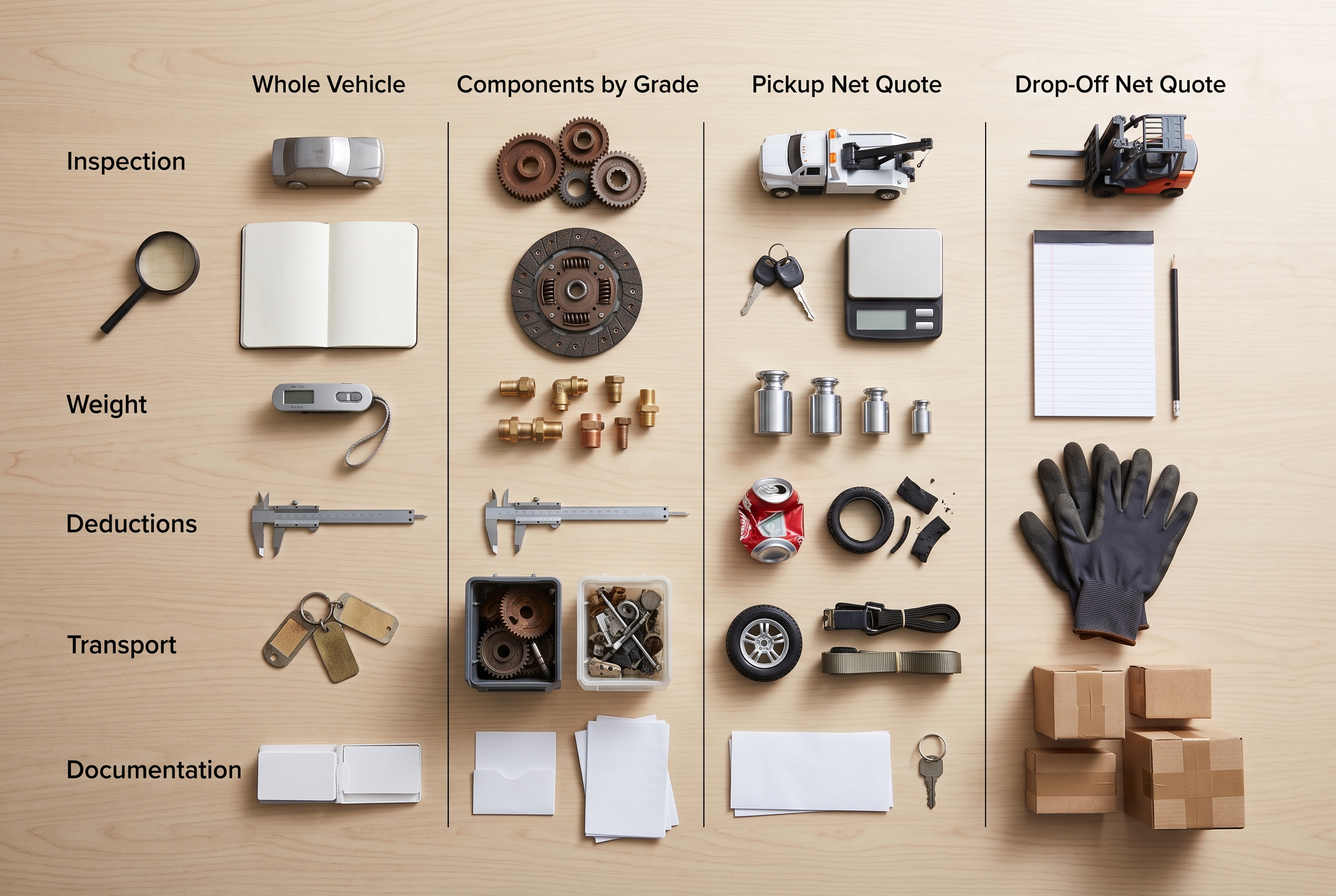
The most useful quote shows how the gross material value becomes the final net amount.
Understand the variables behind automotive scrap prices
Commodity conditions can influence a buyer’s market, but an exchange benchmark is not a local yard quote. The transaction still depends on material identity, grade, actual recoverable weight, contamination, preparation, buyer demand, transport and commercial terms. Avoid content that publishes a timeless “price per vehicle” or “price per part.”
- Material and grade: ferrous and non-ferrous categories can use different valuation methods.
- Actual weight: an estimate, curb weight and scale weight are not the same measurement.
- Completeness: the buyer should define which missing or extra items affect acceptance.
- Condition: contamination, attachments, mixed material, damage or leakage can change handling.
- Logistics: distance, access, loading, equipment and failed pickup can alter net value.
- Administrative requirements: ownership and identity checks may be required before payment.
- Timing: estimates may expire as buyer demand and market conditions change.
Confirm lawful ownership and regulated handling
Ask the buyer which government-issued identification, ownership record, authorization or business document applies to the item. A person selling on behalf of someone else should have clear authority. Do not proceed when the vehicle identification, ownership story or component source is inconsistent.
Ontario’s hazardous waste management guidance explains business responsibilities for regulated waste. Sellers should not drain fluids, dismantle batteries, cut tanks or improvise disposal based on a blog. Report leaks or unsafe conditions and use an appropriate authorized route.
Before transfer, record the buyer’s legal name, facility or pickup details, item description, date, quote version, final weight or unit, grading, deductions, payment evidence and receipt. Keep vehicle-transfer records required for your situation.
Put every automotive scrap quote on one worksheet
| Field | Quote A | Quote B | Why it matters |
|---|---|---|---|
| Exact item | Record description | Record description | Prevents different scopes |
| Method | Whole, grade, pickup or drop-off | Whole, grade, pickup or drop-off | Reveals valuation basis |
| Weight and grade | Estimate or scale method | Estimate or scale method | Shows measurement risk |
| Deductions | List every adjustment | List every adjustment | Turns gross into net |
| Transport | Included or separate | Included or separate | Captures logistics cost |
| Documents | Required proof | Required proof | Supports lawful transfer |
| Final net amount | Written and dated | Written and dated | The comparable decision number |
Automotive scrap quote mistakes to avoid
- Comparing a whole vehicle with a component-grade headline price
- Multiplying curb weight by a public metal price
- Treating an estimate as a guaranteed final payment
- Ignoring pickup, access, sorting or contamination deductions
- Removing hazardous materials without a qualified process
- Travelling before the buyer confirms acceptance and hours
- Proceeding without ownership and identity evidence
- Accepting a changed amount without an itemized explanation
- Keeping no scale ticket, receipt or transfer record
Frequently asked questions
What is the current automotive scrap price?
There is no single current price for every vehicle or component. Obtain a dated quote for the exact item, grading method, weight basis, condition, location and transaction method.
Is pickup or drop-off usually worth more?
It depends on the gross material assessment and logistics. Compare the final net amount after pickup charges or your own safe delivery costs.
Can a public commodity price predict my payout?
No. Benchmarks do not establish local grade, recoverable weight, buyer demand, deductions or transport. Use them only as market context.
Should I dismantle a vehicle before requesting quotes?
Do not dismantle regulated or hazardous components based on price speculation. Ask authorized buyers how the intact unit and lawfully separated materials would be assessed.
Request an item-specific documented quote
Prepare photos, an accurate description, location, access details and lawful ownership evidence. Contact Quick Scrap Metal through its current contact route and ask whether the material is accepted. Require the valuation method, inspection condition, weight and grade basis, deductions, transport, documents, quote expiry and final payment process in writing before transfer.